MATATAG MAPEH Curriculum Guide: What Teachers Need to Know (Grades 4–10)
Teaching MAPEH under MATATAG? First thing to unlearn: the idea that it’s one subject. One name on the class program, sure — but behind it sit two separate curriculum guides, two separate grades on the report card, and two very different ways of teaching and assessing. This MATATAG MAPEH curriculum guide puts both halves on the table: Music & Arts on one side, Physical Education & Health on the other. Who they cover, what each key stage expects, how the grading works, and where the subject actually fits in the school week.
Getting this right matters more than it looks. MAPEH bundles the most hands-on learning areas in the whole curriculum — the singing, the painting, the running, the health habits. Which also makes it the subject hit hardest by congested schedules, missing equipment, and teachers assigned outside their specialization. The revised curriculum answers with fewer, sharper competencies — and a grading system that finally stops asking you to compute four separate component grades every quarter.
What’s ahead: why MATATAG split MAPEH in two, what each side expects at every key stage, the two-component grading rule with a worked example, the official time allotment, classroom strategies that survive real conditions, and the questions teachers ask most.
One Name, Two Subjects: How MATATAG Reorganized MAPEH
Under K to 12, MAPEH meant four components — Music, Arts, Physical Education, Health — computed separately, then averaged into one grade. Anyone who lived through that remembers the quarterly arithmetic: four sets of written works, four sets of performance tasks, four columns squeezed into a single number.
Then in August 2023, DepEd released the MATATAG guides for Grades 4 and 7, and MAPEH arrived reorganized: two distinct learning areas — Music & Arts and Physical Education & Health. Each with its own guide, its own program standards, its own key stage standards, its own grade-level competencies. The report card still says MAPEH on top — but now you compute two grades instead of four and average those each quarter.
That’s the change you feel first. Half the grade-computation work. The freed hours go back where they belong: rehearsals, artworks, games, fitness activities. If your school is still computing four MAPEH components, that’s the old curriculum talking — the MATATAG guides are explicit that the two-component computation replaces it.
Who Takes MAPEH, and When It Rolls Out
MAPEH is Grades 4–10. Nothing in Kindergarten through Grade 3 — MATATAG deliberately holds formal arts and PE until learners are ready for structured skills. The early years get play-based learning and Makabansa instead. The two key stages split cleanly:
- Key Stage 2 — Grades 4 to 6: foundational creative and movement skills, rooted in regional and national identity.
- Key Stage 3 — Grades 7 to 10: innovation and integration — creative work talking to global communities, health and physical literacies woven together.
Rollout follows DepEd Order 010 s. 2024 like everything else: Kinder, Grades 1, 4, and 7 in SY 2024–2025; Grades 2, 3, 5, and 8 in SY 2025–2026; Grades 6, 9, and 10 in SY 2026–2027; full K–10 in SY 2027–2028. Teaching Grade 6, 9, or 10 this year? First year on the revised MAPEH guides for you — read them properly before the quarter starts.
One rumor to bury for good: an April 2023 news report once floated a merged subject mashing Araling Panlipunan and MAPEH together. DepEd debunked it publicly in August 2026 — from Grade 4 onward, AP and MAPEH stay separate, and Makabansa is its own Key Stage 1 area, not a merger of anything. Teach them as the distinct subjects they are.
Music & Arts: Creative Work That Sounds and Looks Like Home
The Music & Arts guide treats creativity as cultural work — not decoration. Learners don’t make “art” in the abstract. They make creative works that carry identity, and the key stage standards name exactly whose.
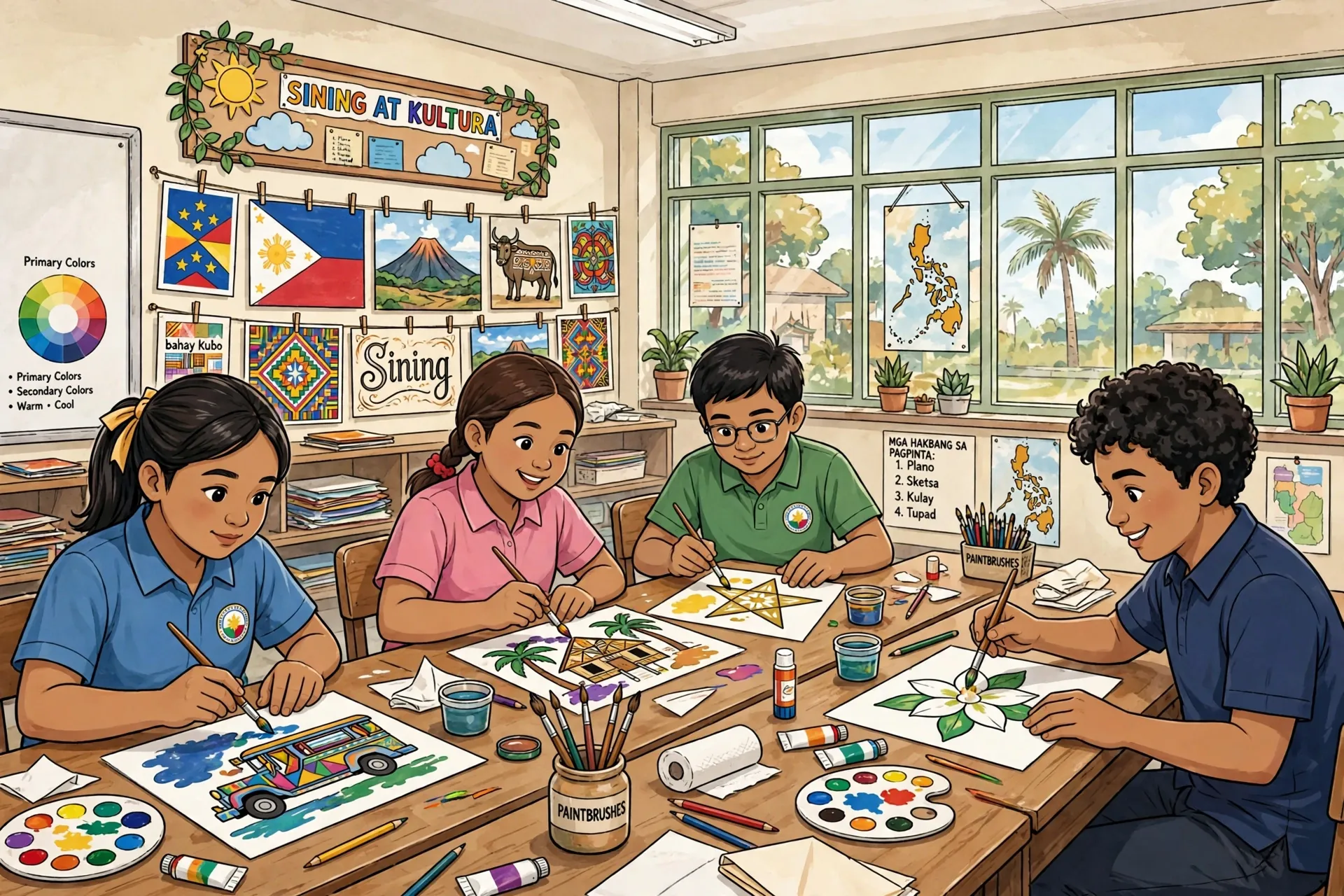
Key Stage 2 (Grades 4–6) is about producing creative works that reflect regional and national identities. Learners pull from the music and art around them — local songs, dances, crafts, stories, festivals — and use them to tell cultural narratives. Picture a Grade 4 class learning a folk song from their own province, then making visual art in response to its story. Technical perfection isn’t the point. The point is learners seeing their own community’s culture as material worth taking seriously.
Key Stage 3 (Grades 7–10) widens the lens: innovation. Learners create works in conversation with global communities, building on the identity work of the earlier stage with stronger technique and original expression. By junior high, a learner should be able to take a tradition they understand, do something new with it — arrange it, reinterpret it, fuse it with other influences — and explain the choices they made.
Assessment runs on evidence you can see and hear. The guide’s examples include performance tasks and skills demonstrations next to the usual quizzes — but the signature method is the portfolio. Learners collect and curate samples across the quarter: performances, artworks, reflections. One portfolio shows you, the learner, and the parents a kind of growth no single test captures. The guides also push self-assessment, peer feedback, and learner journals — students writing about what they tried, what worked, what they’d change. Those journals double as formative assessment data at zero equipment cost.
Physical Education & Health: Moving Well, Living Well
If Music & Arts is about creating, PE & Health is about the body as an instrument — and the guide treats “health” as a full partner, not an afterthought.
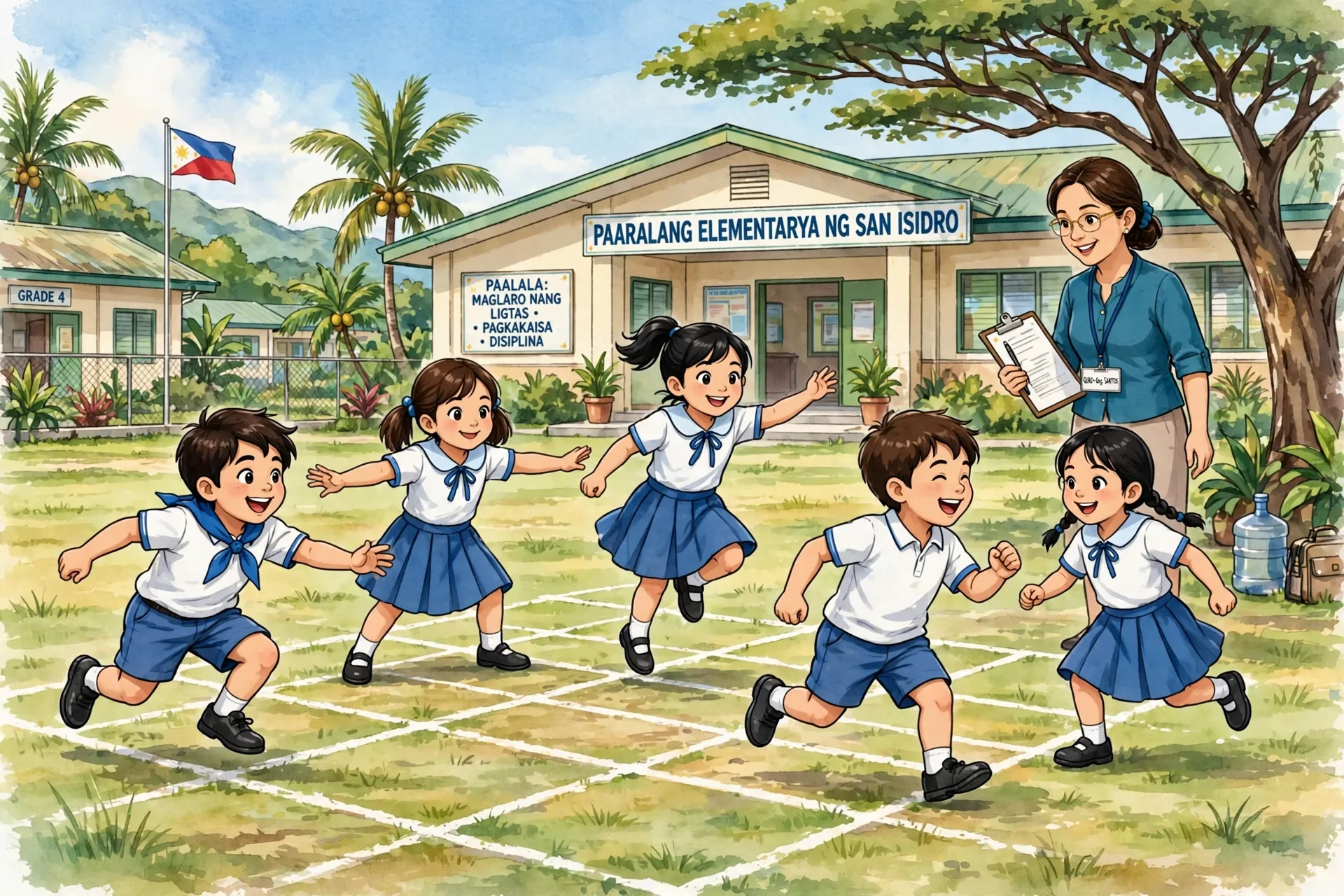
Key Stage 2 centers on fundamental and complex movement: locomotor and non-locomotor skills, coordination, rhythm, teamwork through structured physical activity. Traditional Filipino games get a specific nod in the orientation materials — they build coordination and rhythm while keeping the cultural connection alive. Alongside the movement, learners build basic health awareness: hygiene, safety, habits that protect the body they’re learning to use.
Key Stage 3 integrates the two strands. The standard is physical literacy and health literacy together — learners grasp fitness concepts, nutrition, and mental health, then use that understanding to make informed choices for themselves and their communities. A Grade 10 learner should be able to design a simple personal wellness plan, exercise and diet included, and explain the reasoning behind it. That’s the performance standard working as intended: knowledge demonstrated through a real decision about one’s own life.
What this means for your lesson plans: a PE & Health week isn’t “sports on Tuesday.” The health half needs deliberate space — discussions, journals, small projects on food, rest, hygiene, mental well-being. That counts as legitimate class time, because the standards name those outcomes. When administrators ask what you did with the period, the health-literacy competencies are your answer.
Grading MAPEH: The Two-Component Rule (With a Worked Example)
The rule that replaces the old four-component arithmetic, straight from the August 2023 guides: MAPEH is computed as two components. Music & Arts gets its own grade. Physical Education & Health gets its own grade. Each quarter ends with the average of the two — that’s the MAPEH grade. The final grade for the learning area is the average of the four quarterly MAPEH grades.
The guide walks through an example. Say the component grades look like this:
| Component | Q1 | Q2 | Q3 | Q4 |
|---|---|---|---|---|
| Music & Arts | 90 | 91 | 92 | 95 |
| Physical Education & Health | 91 | 90 | 93 | 96 |
| MAPEH (average) | 91 | 91 | 93 | 96 |
Final MAPEH grade: (91 + 91 + 93 + 96) ÷ 4 = 93. The guides give the practical reason outright: less time computing grades across four components, more time on teaching, learning, and assessment themselves.
Inside each component, the standard DepEd structure still applies — written works, performance tasks, quarterly assessment feeding the component grade, transmuted scores on the usual scale. In MAPEH the performance tasks naturally carry the load: the actual performance, the finished artwork, the fitness demonstration, the wellness plan. Design those first, let the written works support them — not the reverse. For the full computation mechanics, see our walkthrough on how to compute grades in the MATATAG grading system.

Time Allotment: How MAPEH Fits the School Week
DepEd Order 010 s. 2024 set the baseline: 45 minutes a day, five days a week, every learning area. Then teachers pushed back — 45-minute periods meant taking on more sections to fill the six-hour teaching load — and DepEd answered with Order 012 s. 2024, released September 18, 2024, effective from the second quarter of SY 2024–2025. Three options:
| Option | How It Works | What MAPEH Gets |
|---|---|---|
| Option A (original DO 010) | 45 minutes per learning area, 5 days a week; Homeroom Guidance 45 minutes once a week | 45 min × 5 days = 225 min/week |
| Option B | Uniform periods of 50, 55, or 60 minutes. English, Math, Science, and GMRC/Values Ed meet 5×/week; MAPEH, EPP/TLE, AP, and Filipino meet 4×/week | 4 days × 50–60 min = 200–240 min/week |
| Option C | School-proposed combinations (SDS approval required), minimum 5 hours 30 minutes of daily learning contact | Not less than 200 min/week |
The floor is what matters. Under Options B and C, MAPEH can’t drop below 200 minutes a week — same floor as EPP/TLE, Araling Panlipunan, and Filipino. (English, Math, Science, and GMRC/Values Ed sit higher at 225.) Whatever your school picks, check that MAPEH actually gets its minutes. It’s the subject most likely to be quietly squeezed when schedules tighten — precisely because its outcomes don’t show up on a written test.
A scheduling pattern that fits the two-component structure: split the weekly minutes into two longer blocks — one for Music & Arts, one for PE & Health — instead of alternating short daily periods. Longer blocks suit rehearsals, art-making, games, and fitness circuits far better than 45-minute fragments, and since each component carries its own grade, the split maps cleanly onto your gradebook. See our MATATAG time allotment per subject guide for the full per-learning-area breakdown.
Making It Work: Strategies for Real Classrooms
MAPEH usually gets the least equipment and the biggest classes. These strategies are built for exactly that:
- One quarterly performance task feeding both components. A cultural festival, say: Music & Arts assesses the performance and the visual art; PE & Health assesses the folk-dance movement skills plus a short health journal. Shared task, separate marks — record each component on its own.
- One portfolio per learner, two sections inside. A single folder — Music & Arts section, PE & Health section. Evidence stays organized, and quarterly grading becomes review instead of reconstruction. Photograph performances and games; the photo goes in as evidence.
- Teach with what the community already has. Voice and body percussion need zero instruments. Recycled materials become instruments and art supplies. Patintero, luksong tinik, tumbang preso teach coordination, rhythm, and teamwork better than any imported drill — and they plug straight into the Key Stage 2 identity focus.
- Bring the community in. A local musician, dancer, or athlete guesting for one period costs little and hands learners a living example of the competencies. Photos plus a short reflection go in the portfolio.
- Teaching outside your specialization? Lean on the guide’s assessment examples. Self-assessment, peer feedback, learner journals carry real weight in the MATATAG MAPEH guides and need no expertise to run well. You don’t have to be a musician to facilitate a useful peer-feedback session on a class performance — the rubric does the heavy lifting.
- Protect the health half. The temptation is real: let PE & Health slide into “games period.” Block explicit time for the health-literacy competencies — nutrition talk, hygiene routines, mental-health check-ins. Those are assessed outcomes, not optional extras.
Frequently Asked Questions
Is MAPEH one grade or two on the report card?
Two component grades — Music & Arts and PE & Health — computed separately, averaged into the MAPEH grade every quarter. Final MAPEH grade: the average of the four quarterly averages. The four-component computation belongs to K to 12.
Is MAPEH taught in Kindergarten to Grade 3?
No. MAPEH is Grades 4–10. Early grades handle physical and creative development through play-based learning and Makabansa. Structured MAPEH starts at Grade 4.
Did DepEd merge MAPEH with Araling Panlipunan?
No. A 2023 news report floated a merged subject; DepEd clarified in August 2026 that no such merger exists. From Grade 4 on, AP and MAPEH are separate learning areas, and Makabansa stands alone as a Key Stage 1 subject.
How many minutes per week does MAPEH get?
Under DepEd Order 012 s. 2024, schools pick from three options. MAPEH gets 225 minutes a week under Option A (45 × 5 days), or a minimum of 200 a week under Options B and C. The school’s combination needs the Schools Division Superintendent’s approval.
Where can I download the official MAPEH curriculum guides?
DepEd released separate MATATAG guides for Music & Arts and for PE & Health (August 2023, Grades 4 and 7, later grades following the phased rollout). Get them from DepEd’s official site or MATATAG resource pages — and double-check you’re reading the MATATAG version, not the old K to 12 CGs.
I’m not a MAPEH major. How do I teach both sides well?
Start with the guide’s own assessment examples: performance tasks, portfolios, self- and peer assessment, learner journals. They work regardless of specialization. Pair up with a colleague who complements your strengths, bring in community resource persons for demos, and remember — in MAPEH, the learners’ doing is the lesson. Performing, making, moving. Your job: structure it, observe it, assess it fairly.
Conclusion
The MAPEH reorganization is one of MATATAG’s most teacher-friendly changes: two clear guides instead of four tangled components, two grades averaged into one, competencies trimmed to what learners can actually master. The subject still demands what it always did — room to perform, make, move, and practice healthy habits — but the structure around it finally makes sense. Keep the portfolio honest, protect both components’ time in the weekly schedule, and let the learners’ doing carry the learning. That’s what MAPEH was always for.
Sources & References
- Department of Education — MATATAG Curriculum Guide: Music & Arts (Grades 4 and 7), August 2023 (two-component grade computation and assessment strategies).
- Department of Education — MATATAG Curriculum Guide: Physical Education & Health (Grades 4–10), August 2023.
- DepEd Order 012, s. 2024 — flexible class schedule guidelines; reported by the Philippine Daily Inquirer, September 19, 2024 (newsinfo.inquirer.net) and the Manila Bulletin.
- Daily Tribune, August 8, 2026 — “DepEd debunks claims of AP-MAPEH merger.”
- Teach Pinas — MATATAG Curriculum Guide PDF compilation (lists Music & Arts and PE & Health guides for Grades 4 and 7).
- Prezi — “Unified Orientation on MATATAG MAPEH for Grades 4-10” (key stage standards and assessment overview).