MATATAG English Curriculum Guide: Key Stages, Competencies & Teaching Tips (2026)
Let me tell you about Mrs. Santos. (Not her real name, but she’s real — I’ve watched a dozen teachers just like her.) First week of classes, Grade 4, brand-new MATATAG English curriculum guide on her desk.
She flips through it. It’s thinner than the old one, which feels like good news for about ten seconds. Then she hits the competency codes.
EN4LR-III-1. EN4SW-III-2. EN4VR-III-1.
She looks up at me and goes: “Okay, but what do I actually teach on Monday?”
Fair question. Great question, actually. And if you’re holding that same MATATAG English curriculum guide right now, this is the walkthrough I wish someone had handed her.

What They Did to English (And Why)
Here’s the backstory in one paragraph. The old K–12 English guides were bloated. Everyone knew it — teachers, principals, even DepEd eventually. Too many competencies, too little time, zero breathing room. So when MATATAG came along in 2023, English got stripped down and rebuilt around a simple idea: fewer things, taught deeper, coming back around every year at a harder level.
That’s the spiral at the heart of the MATATAG English curriculum guide. Your Grade 4s meet a concept. Your Grade 5s meet it again, tougher. By Grade 6, they own it. Sounds obvious when you say it like that. It wasn’t how the old guides worked.
The other big change? Freedom. Real freedom, not the fake kind. The old guides basically told you what to do each week. The new one says: here’s what this quarter’s competencies deserve in terms of time — you figure out how to bundle them. Some teachers heard that and felt trusted. Others heard it and felt abandoned. Both reactions are valid.
The Three Things That Actually Matter
Forget the policy-speak for a second. Underneath all the documents, DepEd wants three things out of English. Nail these and you’re teaching the curriculum right, whatever your lesson plan looks like.
First: literacy that goes somewhere. Not just “can read the words.” Can your learners read something, figure out what it means, argue with it a little, and make something new out of it? A kid who reads a news article and asks “but who wrote this and why” — that’s the goal. Print, screens, videos, all of it counts.
Second: knowing how to talk to whom. Grammar’s only half the game. The other half is judgment — the difference between how you text your best friend and how you write to your principal. Learners need both the rules and the instincts. That’s what “communicative competence” means when you strip the jargon off.
Third — and don’t sleep on this one — staying Filipino. English class under MATATAG is supposed to carry our stories, our traditions, our values. Not as decoration. As the actual material. When a Grade 7 class writes poems about their town fiesta, that’s not a fun side activity. That’s the curriculum doing exactly what it was built to do.
So Where Does Your Grade Fit?
Quick map. Three stages, three different jobs:
| Stage | Grades | The job |
|---|---|---|
| Key Stage 1 | 1–3 | Literacy — sounds, words, first sentences |
| Key Stage 2 | 4–6 | Language — using English for real purposes |
| Key Stage 3 | 7–10 | Text — mastering different kinds of writing |
Now, the thing that trips everyone up: Grade 1 has no English. I know. I had to double-check too. Six-year-olds do Reading and Literacy in their first language. English walks into the classroom in Grade 2 — rhymes, phonics, sight words, little sentences about family and everyday stuff.
Grades 4 to 6? That’s where it gets serious. Kids stop just reading and start reading for reasons. Enjoyment. Information. Figuring out if something’s true. Writing stops being copy-the-sentence and starts being say-something-real. A Grade 4 class in Quarter 3 is typically juggling three threads: understanding stories (those EN4LR codes), messing with word meanings — literal versus implied (EN4SW) — and reading pictures and visuals (EN4VR).
And 7 to 10? The training wheels are off. Four kinds of text — literary, informational, academic, transactional — analyzed and produced at a level that would’ve been senior-high work under the old system.

Those Codes Aren’t as Scary as They Look
Okay. The codes. Let me just decode one and you’ll never fear them again.
EN4LR-III-1. Read it left to right: EN (English, obviously), 4 (Grade 4), LR (Listening and Reading — the skill family), III (third quarter), 1 (first competency in the list). The description next to it says “Comprehend literary texts.” That’s it. That’s the whole mystery.
Once you’ve got the pattern, try reading your quarter’s codes out loud. You’ll start seeing which ones want to be taught together. EN4LR-III-1 (understand stories) plus EN4SW-III-1 (word meanings) plus EN4VR-III-1 (visuals)? That’s not three separate lessons. That’s one great week built around one good story. The MATATAG English curriculum guide is practically winking at you.
The Skill Families, Without the Jargon
Every key stage groups its competencies into what the documents call “subdomains.” Here’s what they actually are:
Little kids (Grades 2–3) work on six things: hearing sounds in words, matching sounds to letters, building vocabulary, noticing how grammar works, understanding what they read, and making their own little texts. Foundations. Bricks.
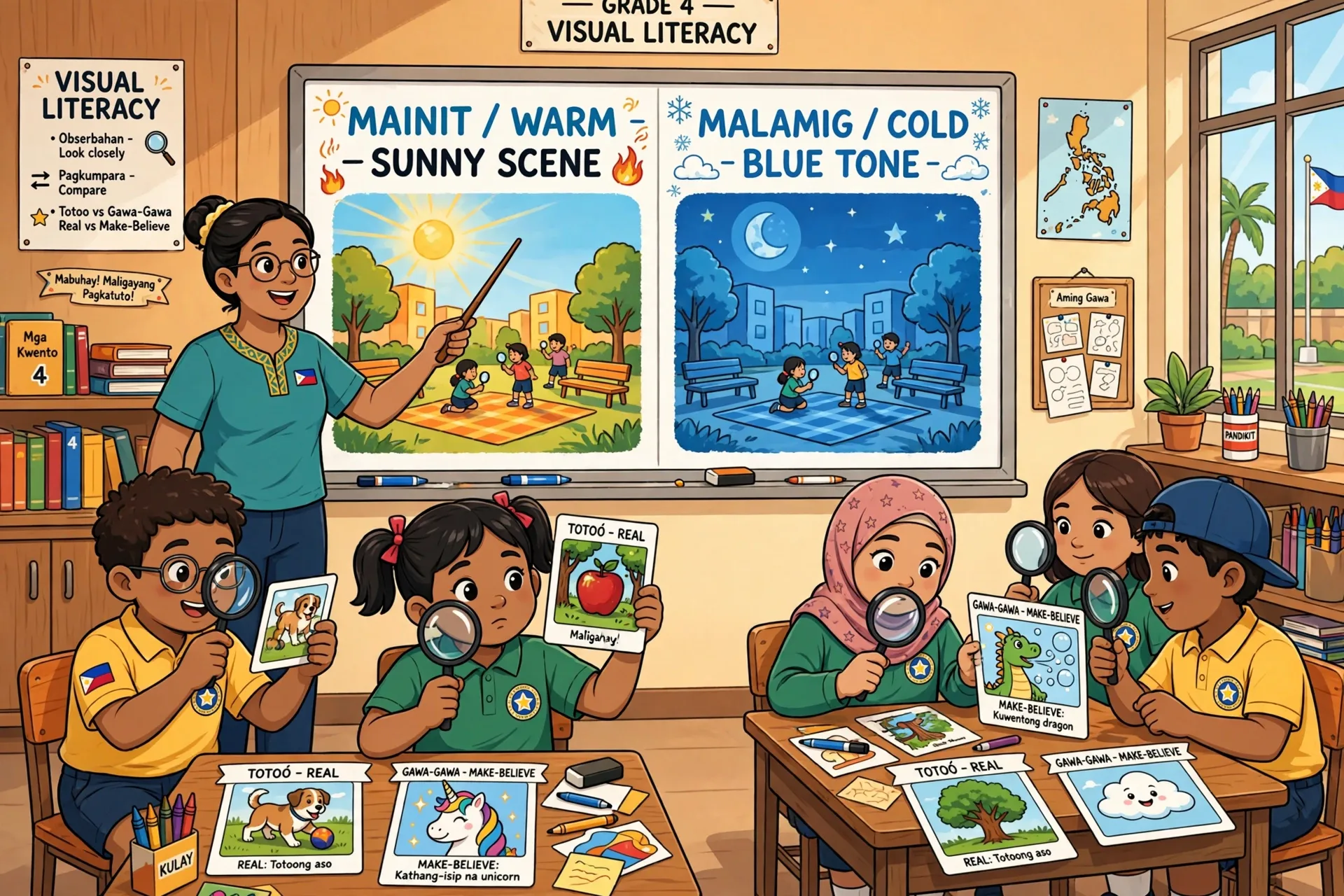
Grades 4–6 compress it to three: taking language in (listening, reading), putting language out (speaking, writing), and — this one’s new and people underestimate it — viewing. Reading images. Interpreting colors and visuals. Sorting real pictures from made-up ones. It’s assessed, by the way. Don’t treat it as the fun Friday filler.
Grades 7–10 stop organizing by skill at all. Instead it’s: what kind of text are we conquering this quarter? A story? A news report? An academic essay? A letter that actually has to get something done?
The Time Question
Everyone asks. Here’s the answer: 45 minutes a day, five days a week, Grades 2 through 10. Same as Filipino, Math, Science. Under the MATATAG English curriculum guide, English is a daily subject — DepEd didn’t trim its hours, just its clutter.
Where Teachers Go Wrong (I’ve Watched This Happen)
Can I be blunt for a minute? Here are the mistakes I keep seeing, and I say this with love:
Teaching every competency like it’s its own island. Stop. The MATATAG English curriculum guide wants you to bundle. One story can carry a reading competency, a speaking competency, and a viewing competency in a single week. Teaching them separately triples your prep for literally no reason.
Skipping the visual stuff. I mentioned this already because it keeps happening. Those image-and-color competencies look skippable. They are not. Ten minutes sorting real vs. make-believe pictures, done. Competency covered.
Teaching last year’s level again. This is the silent killer. The spiral only works if you check what learners did before and teach the next step. The scope-and-sequence chart is right there in the guide. Glance at it before you plan. Please.
Reaching for generic materials when local ones are better. A story about snow teaches plot structure fine. A legend from your learners’ own province teaches plot structure and checks the cultural identity box. Same lesson. Double credit. Why wouldn’t you?
Planning Monday on Sunday night. I get it, we’ve all been there. But map the quarter first — cluster the competencies, see the arc — then break it into weeks (our step-by-step MATATAG lesson plan guide walks through the full exemplar format if you need a template). Teachers who switch to this say planning gets faster after the first quarter, not slower. Trust the process.
What a Good Week Actually Looks Like
Theory’s nice. Let me show you. Grade 4, Quarter 3. Your cluster: understand stories, literal vs. implied meaning, visual elements. One local legend. Five days. Watch:
Monday. You read the legend aloud — pick a good one, with a trickster or a transformation, kids love those. They name the characters, the setting, what happened first, next, last. Basic comprehension. Done.
Tuesday. Back to the legend’s trickiest lines. “His heart turned to stone” — did it, literally? What’s the sentence saying versus what does it mean? Watch their faces when this clicks. It’s my favorite lesson of the week every time.
Wednesday. Two pictures of the same scene. One’s all warm golds, the other’s cold blues. Same legend, totally different feeling. That’s visual literacy, and it took fifteen minutes.
Thursday. They retell it to a partner — out loud first, always — then write three sentences of their own. Reading becomes speaking becomes writing. That’s the receptive-to-productive pipeline the curriculum keeps talking about, happening live.
Friday. Quick check, low stakes: three new sentences, mark them literal or implied. Then draw one scene from the legend, choosing colors for the mood. You just assessed all three competencies without a single formal test.
One story. Five days. Three competencies. This is what the guide’s flexibility is for.
Where to Download the Official MATATAG English Curriculum Guide
The official MATATAG English curriculum guide is the MATATAG Curriculum: English (Grades 2–10), August 2023. It floats around as a PDF — DepEd channels, teacher resource sites, the usual places — and DepEd’s own MATATAG FAQ is the safest place to sanity-check what you’re reading. Just verify you’re looking at the August 2023 version covering Grades 2–10, because older drafts still circulate and they’ll confuse you. Teaching Grade 1? You want the separate Reading and Literacy guide — different document entirely.
Frequently Asked Questions
So English really starts in Grade 2?
Really. Grade 1 is Reading and Literacy in the first language. English joins in Grade 2.
Is 45 minutes a day enough?
It’s the same as every other core subject. The curriculum’s gamble: focused, spiraling competencies beat longer hours of scattered ones. Jury’s still out, but the logic’s sound.
Do I have to follow the guide’s order?
No. That’s the whole point of the redesign. Quarter-level durations, your sequencing. Cluster what belongs together.
How are English grades computed under MATATAG?
Same rules as before: per DepEd Order No. 8, s. 2015, English (a language subject) splits into 30% written works, 50% performance tasks, and 20% quarterly assessment. Our step-by-step grading guide walks through a full worked computation so you can check your class records line by line.
What about Mother Tongue now?
RA 12027 (lapsed into law October 10, 2024) ended mandatory mother tongue as the medium of instruction for K-3; DepEd Order 020, s. 2025 set Filipino and English as the primary media, with regional languages as auxiliary support. The policy word for it is translanguaging. Use it without guilt.
Where are the ready-made lesson plans?
Scribd, StudocU, DepEd Club — teachers share weekly logs by grade and quarter. Great starting points. Just check they match your quarter’s actual competencies before using them.
My class is behind. Where do I even start?
The scope-and-sequence chart. Find what they were supposed to do last year, run a quick diagnostic on that, and start where the gaps are. The spiral means last year’s work is this year’s foundation — use that.
Conclusion
Mrs. Santos — remember her? — figured it out by October. She stopped teaching the codes in order like a checklist and started building weeks around stories. Her planning time dropped. Her kids’ scores didn’t.
The MATATAG English curriculum guide is a better document than what came before it. But documents don’t teach. You do. Cluster the competencies. Spiral them upward. Root everything in your learners’ world. Literacy, language, text — that’s the map. Your classroom is the territory.
Sources & References
- Department of Education — MATATAG Curriculum: English (Grades 2–10), August 2023
- Department of Education — MATATAG Curriculum: Reading and Literacy (Grade 1), August 2023
- DepEd Order No. 010, s. 2024 — policy guidelines on MATATAG implementation
- DepEd Order No. 020, s. 2025 — policy on the medium of instruction for Kindergarten to Grade 3, implementing RA 12027
- Republic Act No. 12027 — discontinues the use of the mother tongue as medium of instruction from Kindergarten to Grade 3 (lapsed into law, October 10, 2024)
- Bella Cariaso, “DepEd: Use both English, Filipino to teach in K-3,” The Philippine Star, July 5, 2025
- DepEd Club, Scribd, StudocU — teacher-shared curriculum guides and weekly lesson logs