MATATAG Makabansa Curriculum Guide: What Teachers Need to Know (Grades 1–3)
Every curriculum reform invents at least one subject that sends teachers to Google at midnight. In MATATAG, that subject is Makabansa. Ask a Grade 1 teacher what she teaches at 9:40 in the morning and she will answer without missing a beat. Ask her what Makabansa is supposed to produce by the end of the school year and you will get a longer pause. This MATATAG Makabansa curriculum guide closes that gap: the subject did not exist two years ago, and it folds civics, culture, history, art, and health into a single daily period for six- and seven-year-olds.
Here is the short version. Makabansa — from makabayan, love of country — is the MATATAG learning area for Grades 1 to 3 that consolidates the early grades’ social and cultural formation into one coherent subject. DepEd designed it as a transdisciplinary curriculum: instead of teaching civics on Monday and art on Tuesday, one class period weaves together Sibika (civics), Sining at Kultura (arts and culture), Kasaysayan (history), and Kagalingang Pangkalusugan (health) around big ideas a young child can actually grasp — family, community, country. This MATATAG Makabansa curriculum guide walks through all of it: what the subject is and is not, what each grade covers, how much time it gets in the week, how it is graded, and what actually works when you teach it.
Below: the official definition from DepEd’s shaping paper, the grade-by-grade scope, the time allotment under the latest orders, the assessment weights, how Makabansa differs from Araling Panlipunan, classroom strategies that fit a 40-minute period, answers to the questions teachers ask most, and a short note for parents — everything a working matatag makabansa curriculum guide should cover.
What Makabansa Actually Is (and What It Isn’t)
Start with DepEd’s own words, because the official definition is unusually clear. The MATATAG shaping paper describes Makabansa as “isang transdisiplinaryong kurikulum na naglalayong makahubog ng isang aktibong mag-aaral” — a transdisciplinary curriculum meant to shape an active learner. Its building blocks, the paper says, are the “big ideas” (malalim na kaisipan) drawn from four fields: Sibika, Sining at Kultura, Kasaysayan, and Kagalingang Pangkalusugan. The qualities it wants to develop have Filipino names worth remembering: pagkakakilanlan (identity), pagkamalikhain (creativity), pagkamalusog (health), and pakikipag-ugnayan sa kapwa at sa lipunan (relating with others and with society). The end goal is a holistic Filipino learner equipped with 21st-century skills. That official framing is the anchor of this matatag makabansa curriculum guide.
Two common confusions are worth clearing up early, because this MATATAG Makabansa curriculum guide keeps returning to them. First, Makabansa is not just Araling Panlipunan renamed. Araling Panlipunan still exists — it takes over in Grade 4 as a disciplinary subject with history, geography, economics, and civics strands. Makabansa is the on-ramp: integrated, concrete, and experiential, built for children who are still learning to read. Second, Makabansa is not Values Education either. Values formation is GMRC’s territory in the early grades. Makabansa touches values constantly — you cannot teach community without them — but its center of gravity is identity and belonging: who I am, where I come from, and what my community expects of me.
Who Takes Makabansa, and When It Started
Makabansa is a Grades 1 to 3 learning area. It does not appear in Kindergarten, and it does not continue into Grade 4 — from there, Araling Panlipunan picks up the thread. The per-grade line-up looks like this:
| Grade level | Learning areas (MATATAG) |
|---|---|
| Grade 1 | Language, Reading and Literacy, Mathematics, Makabansa, GMRC |
| Grade 2 | Filipino, English, Mathematics, Makabansa, GMRC |
| Grade 3 | Filipino, English, Mathematics, Science, Makabansa, GMRC |
| Grade 4 and up | Filipino, English, Mathematics, Science, Araling Panlipunan, EPP/TLE, MAPEH, GMRC/Values Education — no Makabansa |
The subject arrived with the phased rollout in DepEd Order No. 010, s. 2024: Grade 1 shifted to MATATAG in SY 2024–2025, Grade 2 in SY 2025–2026, and Grade 3 in SY 2026–2027. So this school year is the first time all three grades are teaching Makabansa at once. If you are handling Grade 3 this year, you are teaching the subject’s first full cohort — expect the curriculum guide to feel new, because it is. This matatag makabansa curriculum guide is written for exactly that teacher: new to the subject and short on time.
What the MATATAG Makabansa Curriculum Guide Covers, Grade by Grade
The smartest thing about the Makabansa design is its progression, which follows the oldest principle in early childhood education: start with what the child can touch, then widen the circle. Grade 1 begins with the self, the family, and the school — the three places a six-year-old actually lives. Grade 2 steps out into the community: the barangay, its helpers, local traditions, the first simple stories of heroes and national symbols. Grade 3 widens further into culture, livelihood, and health habits, with a deeper look at the community as a working whole. Nothing is taught as abstract fact; everything is anchored to something the child has seen, drawn, or visited. The rest of this matatag makabansa curriculum guide follows that same widening circle, grade by grade.
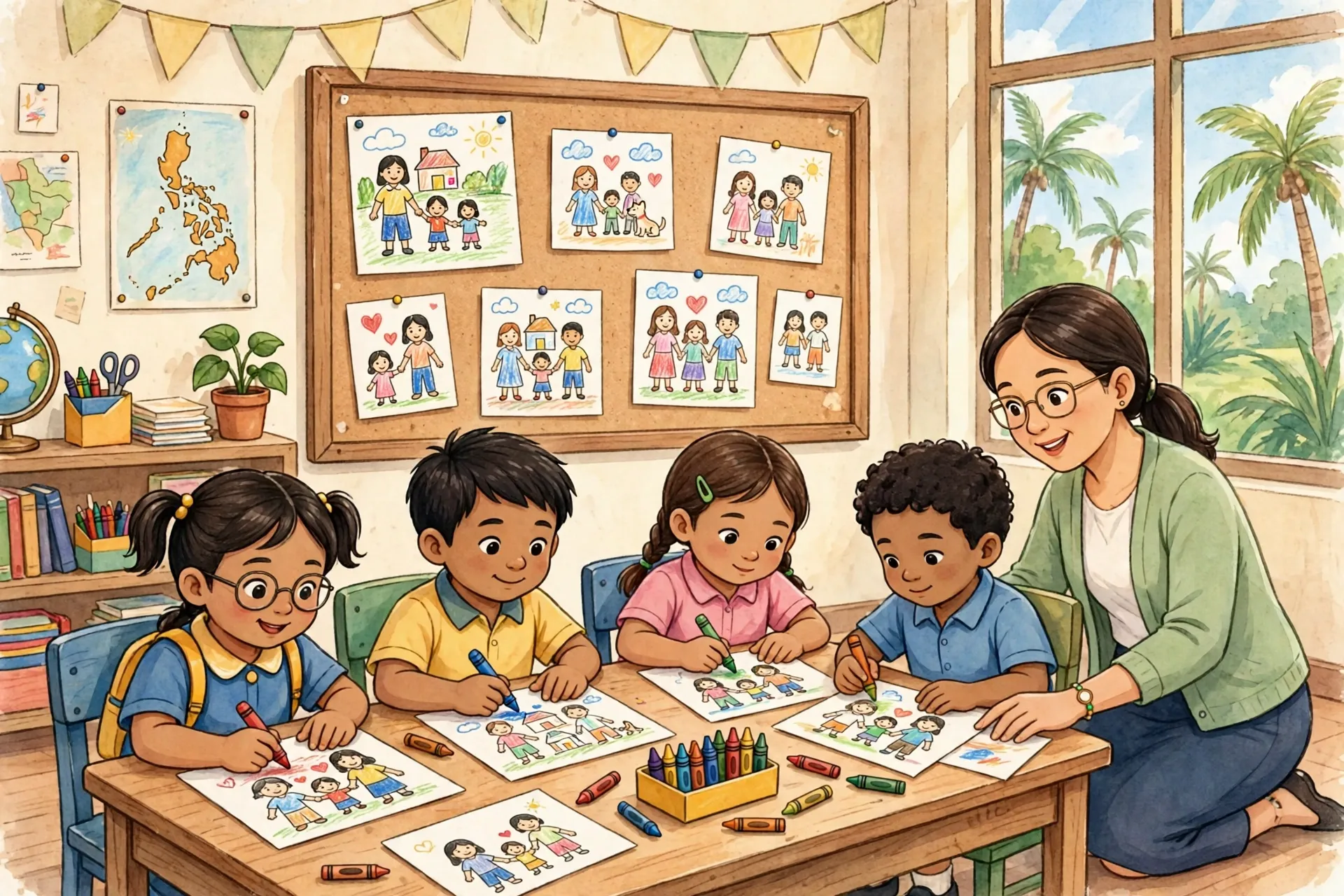
To see the grain size of the official curriculum guide, look at a real sample: the Grade 1 second-quarter theme, “Tayo bilang kasapi ng pamilya” (Us as members of the family). The content standard expects learners to understand the roles they play and the duties they carry as family members. The performance standard asks them to produce an artwork — a likhang-sining — showing the roles and duties of family members. And the learning competencies get specific: explain the concept of family as made up of different forms (two-parent, solo parent, extended family, and others), explain the role and duties of each member, and show appreciation for those roles. One quarter, one theme, a handful of competencies, and an output a six-year-old can actually make. That is the decongestion promise working as intended.
| Grade | Focus of the year | Sample themes and topics |
|---|---|---|
| Grade 1 | Self, family, school | Knowing oneself and one’s family; roles and duties of family members; the school as a second home; basic good manners in daily routines |
| Grade 2 | Community and nation | The barangay and its helpers; local traditions and celebrations; national symbols (flag, anthem); simple stories of Philippine heroes |
| Grade 3 | Culture, livelihood, well-being | Community livelihoods and occupations; Filipino culture and arts; caring for one’s health and the environment; the community working together |
Notice, as this matatag makabansa curriculum guide keeps pointing out, how the arts and health strands surface naturally inside these themes rather than as separate lessons. A Grade 2 lesson on the barangay fiesta is simultaneously culture (the celebration), art (the decorations the class makes), and civics (why communities celebrate together). A Grade 3 lesson on health folds kagalingang pangkalusugan into daily habits — handwashing, safe play, clean surroundings — instead of lecturing about it. That is what “transdisciplinary” means in practice: the boundaries between the four source fields dissolve inside one meaningful activity.
Makabansa vs Araling Panlipunan: Don’t Confuse the Two
The question comes up in every faculty room: if Makabansa covers civics and history, what is left for Araling Panlipunan? The answer is that they are built for different minds. This MATATAG Makabansa curriculum guide treats the subject as preparation; Araling Panlipunan, from Grade 4 onward, is the discipline itself.
| Makabansa (Grades 1–3) | Araling Panlipunan (Grades 4–10) | |
|---|---|---|
| Design | Transdisciplinary: civics, arts and culture, history, and health integrated around big ideas | Disciplinary: history, geography, economics, and civics as distinct strands |
| Starting point | The child’s immediate world — self, family, school, community | The region and the nation — Philippine history, government, economy |
| Method | Concrete and experiential: drawing, singing, role-play, short community walks | Increasingly analytical: reading sources, mapping, project-based civic work |
| Typical output | Artwork, simple maps, class presentations, performances | Reports, research, debates, community projects |
| Assessment feel | Performance tasks dominate; the product is the proof | Heavier written work alongside performance tasks |
Think of it as a relay. Makabansa builds the emotional foundation — pride in family, familiarity with the community, the habit of noticing how people live together. Araling Panlipunan later gives that foundation its vocabulary: timelines, maps, constitutions, economies. A child who spent Grade 2 drawing her barangay and interviewing the tanod does not arrive in Grade 4 as a blank slate; she arrives with something to attach the new terms to.
Time Allotment: Makabansa’s Slot in the School Week
Under DepEd Order No. 010, s. 2024, Makabansa gets 40 minutes a day in Grades 1 and 2, and 45 minutes a day in Grade 3 — five days a week, the same daily treatment as the other core learning areas in the early grades. It is not a twice-a-week special subject; it sits in the daily line-up between the literacy and numeracy blocks, which tells you how seriously DepEd takes identity formation in the foundation years. It is a conviction this matatag makabansa curriculum guide shares.
One caveat worth knowing: DepEd Order No. 012, s. 2024 later gave schools flexibility to adjust class schedules to their staffing and classroom realities — uniform 50-, 55-, or 60-minute periods, or a school-proposed combination within set weekly minute floors, subject to division approval. Most schools kept the standard daily slot for the early grades, but if your school adopted a modified schedule, confirm Makabansa’s placement with your school head rather than assuming the default.
Forty minutes sounds short until you plan for it honestly. It is enough for one strong activity with a clear output — a story plus a drawing, a short walk plus a sharing circle, a song plus a simple worksheet. It is not enough for two activities, and teachers who try to squeeze in both end up rushing the part that matters. Plan one, and let the output be the lesson’s evidence.
How Makabansa Is Graded
Makabansa is graded under the same DepEd Order No. 8, s. 2015 rules as every other subject, and it sits in the assessment cluster with Araling Panlipunan — which means performance tasks carry the most weight by design:
| Component | Weight | What it looks like in Makabansa |
|---|---|---|
| Written Works | 30% | Short quizzes, picture-based worksheets, labeling activities |
| Performance Tasks | 50% | Artwork (likhang-sining), role-plays, simple community maps, class presentations, songs |
| Quarterly Assessment | 20% | Periodical test on the quarter’s themes |
Half the grade on performance is not an accident — it matches the subject’s performance standards, which keep asking learners to make something. The Grade 1 family quarter does not end with a test about families; it ends with an artwork about families. Grade accordingly: build a simple rubric around the output (did it show the roles? is it the child’s own work? can the child explain it?), keep the written works light and picture-based for early grades, and reserve the quarterly test for checking that the big ideas stuck. That is the assessment posture this matatag makabansa curriculum guide recommends: performance first, paperwork light. For the full computation walkthrough with a worked example, see our guide on how grades are computed in the MATATAG grading system.
Teaching It Well in 40 Minutes
Makabansa rewards teachers who think like activity designers rather than lecturers. The principles below are the most transferable ones this matatag makabansa curriculum guide can offer, and they hold up across Grades 1 to 3:
- Start with the child’s world, not the nation’s. A lesson on community helpers lands better when it begins with “who did you see on your way to school?” than with a definition of a barangay. The abstract terms can wait until the experience exists.
- Let the art do the teaching. When the performance standard itself asks for a likhang-sining, the drawing is not a time-filler after the “real” lesson — it is the lesson. A child who draws her family’s dinner table and labels who does what has demonstrated the competency more convincingly than any worksheet could.
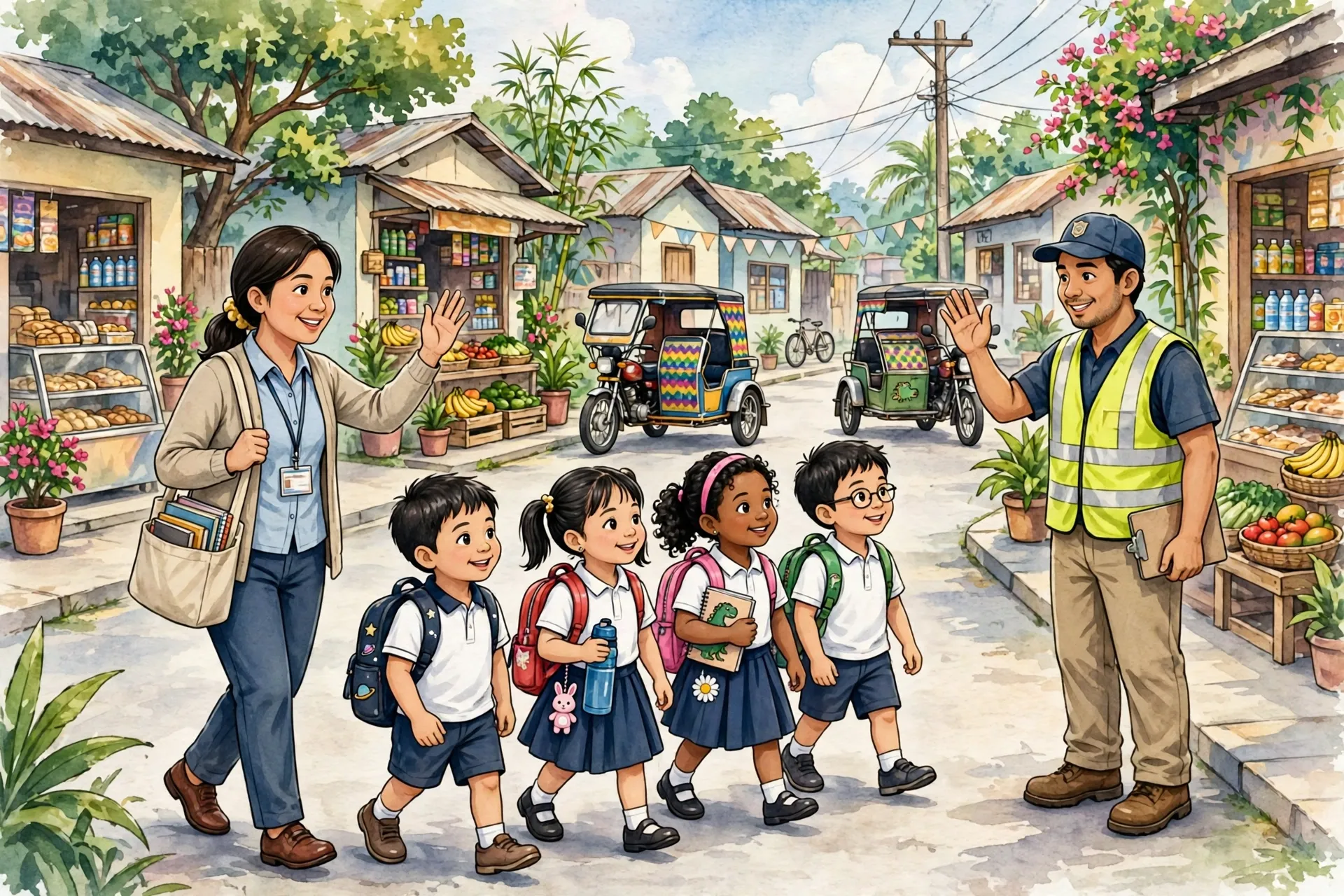
- Use the community as your laboratory. Short, supervised walks — to the barangay hall, the market, the chapel — cost nothing and produce the raw material for weeks of lessons. Where walks are not possible, invite the material in: a parent who is a nurse, a tanod, a vendor, each willing to answer ten minutes of curious questions.
- Keep the language concrete. Makabansa works best in the language children actually speak at home — in most classrooms, that means Filipino with simple, concrete nouns. This also tracks the wider language policy shift: with RA 12027 ending mandatory mother-tongue instruction, Filipino and English are the media of instruction, and Makabansa’s vocabulary (pamilya, pamayanan, bayan) sits naturally in Filipino.
- Bring parents into the quarter’s theme. The family quarter practically begs for a family-tree project; the community quarter begs for a weekend walk with a parent. Parents who understand the theme reinforce it without being asked to “teach” anything.
A workable 40-minute flow: five minutes of recall and routine, ten minutes of story or picture talk that introduces the day’s idea, fifteen minutes on the single main activity, and ten minutes of sharing where children show and explain their output. If you need the formal MATATAG lesson structure around this flow, our step-by-step lesson plan guide walks through the official exemplar format with a worked example.
A Short Note for Parents
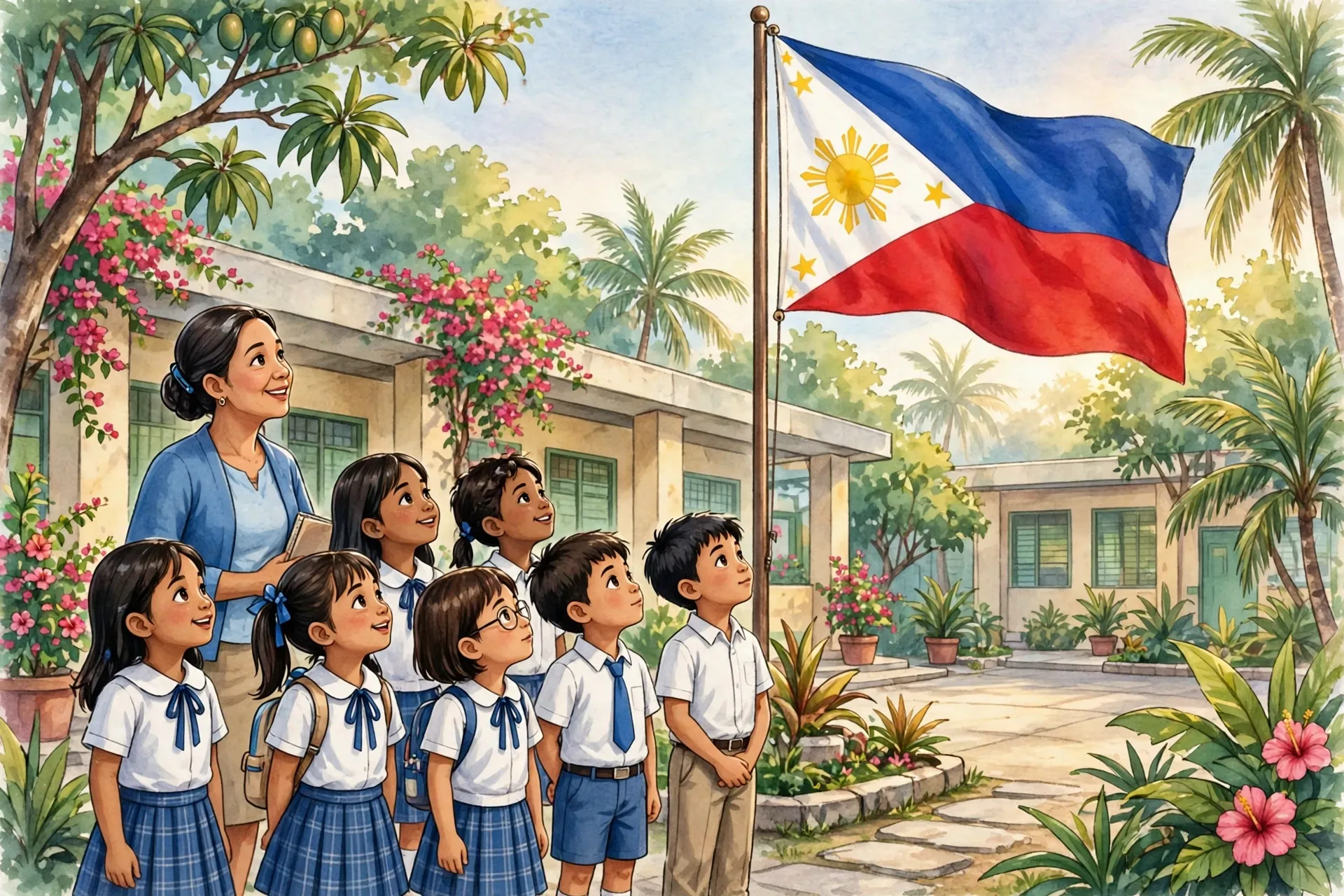
If your child brings home a family drawing, a simple map of your street, or questions about what lolo did for a living, that is Makabansa homework doing its job. The subject asks children to notice the world immediately around them, and you are the richest source they have. Tell the family stories. Point out the barangay hall, the health center, the people whose work keeps the neighborhood running. Join the school’s flag ceremony when you can. None of this requires money or materials — just attention, which is exactly what the subject is trying to build in your child anyway.
Frequently Asked Questions
What does “Makabansa” mean?
It comes from makabayan (love of country, patriotism). In the MATATAG Curriculum it names the Grades 1–3 learning area that builds national identity, cultural appreciation, and civic awareness in young learners — the “MA” in MATATAG itself stands for Makabansa.
Is Makabansa the same as Araling Panlipunan?
No. Makabansa is the integrated, experiential learning area for Grades 1 to 3, drawing together civics, arts and culture, history, and health around the child’s immediate world. Araling Panlipunan begins in Grade 4 as a full disciplinary subject — history, geography, economics, civics — and continues through Grade 10.
Which grades take Makabansa?
Grades 1, 2, and 3 only. Following the phased rollout of DepEd Order No. 010, s. 2024, Grade 1 started in SY 2024–2025, Grade 2 in SY 2025–2026, and Grade 3 in SY 2026–2027 — so all three grades are on the subject this school year.
How many minutes is Makabansa per day?
Forty minutes daily in Grades 1 and 2, and 45 minutes daily in Grade 3, five days a week, under the standard DepEd Order No. 010, s. 2024 schedule. Schools that adopted the flexible scheduling under DepEd Order No. 012, s. 2024 may use adjusted periods — check with your school head.
What language is Makabansa taught in?
In practice, Filipino — the subject’s core vocabulary (pamilya, pamayanan, bayan, kultura) is most natural there, and it aligns with the post-RA 12027 language policy where Filipino and English serve as the media of instruction. Keep sentences short and concrete for early grades regardless of the language.
Is there an official Makabansa curriculum guide PDF?
Yes. DepEd released official curriculum guides for Makabansa per grade level, with program standards, content and performance standards, and learning competencies per quarter. Ask your school head or check DepEd’s learning resource portals — and read the actual guide for your grade before planning the quarter, since summaries (including this one) cannot replace it.
How is Makabansa different from what came before it?
It consolidates the early grades’ civic, cultural, and health formation — previously spread thin across several lessons — into one coherent daily subject built on a few big ideas per quarter instead of long competency lists. The emphasis moved from memorizing facts to producing something: an artwork, a map, a performance that shows what the child understood.
Will Makabansa continue in Grade 4?
No. From Grade 4, Araling Panlipunan takes over the social-studies line, joined by the full set of Key Stage 2 learning areas. The identity and culture thread Makabansa started continues there — your Grade 3 pupils will meet it again, with maps and timelines attached.
Conclusion
Makabansa is DepEd’s bet that patriotism is not taught but grown — from the family table outward to the barangay, and eventually to the nation. For teachers, the subject asks for a shift in habits: fewer facts dictated, more experiences designed; fewer worksheets, more artwork with something to say. The curriculum guide gives you the themes and the standards; the forty minutes a day give you the space. Use both well, and the child who can explain her family’s roles in Grade 1 becomes the citizen who understands her country’s in Grade 10. That is the whole arc of this MATATAG Makabansa curriculum guide in one sentence — and it is worth teaching carefully.
Sources & References
- DepEd Order No. 010, s. 2024 — Policy Guidelines on the Implementation of the MATATAG Curriculum (deped.gov.ph)
- DepEd Order No. 012, s. 2024 — flexible implementation guidelines, via Inquirer.net (“DepEd issues new guidelines for Matatag Curriculum implementation”)
- DepEd MATATAG Curriculum Shaping Paper presentation — Makabansa learning area goals and curriculum design (transdisciplinary model; big ideas from Sibika, Sining at Kultura, Kasaysayan, Kagalingang Pangkalusugan)
- DepEd Order No. 8, s. 2015 — Policy Guidelines on Classroom Assessment for the K to 12 Basic Education Program (assessment weights)
- MATATAG Curriculum Guide for Makabansa, Grade 1 — sample quarterly content: “Tayo bilang kasapi ng pamilya” (content/performance standards and learning competencies)