MATATAG Science Curriculum Guide (Grades 3-10): What Teachers and Parents Must Know
If you searched for a curriculum guide in science under MATATAG, you probably want a straight answer, not a 72-page DepEd PDF. Here it is: Science under the MATATAG Curriculum runs from Grade 3 to Grade 10, it is organized into four domains, and each quarter of the school year is devoted to one domain. That one fact — one domain per quarter — explains almost everything about how Science is taught now.
There is also a surprise in here for parents. If your child is in Grade 1 or Grade 2, you will not find Science on their class schedule at all. That is not a mistake. Under MATATAG, Science starts in Grade 3, once learners have the reading and number sense to actually do inquiry work. This guide walks through the four domains, the quarter-by-quarter sequence for every grade, the topics teachers cover, the weekly minutes, and how Science changed from the old K-12 version. There is a Science topics finder tool and a free checklist at the end.
What Is the Curriculum Guide in Science (MATATAG)?
The official document is called “MATATAG Curriculum: Science (Grades 3-10),” released by DepEd in August 2023. It is the curriculum guide every public school follows for Science from Grade 3 up to Grade 10. Private schools that adopt MATATAG use the same guide.
DepEd describes the goal in plain terms: learners who are scientifically, environmentally, and technology literate — kids who can solve problems, take care of nature, make informed decisions, and explain what they think. That is a bigger ambition than just passing a Science test. It is why the guide is built around three strands that run through every grade: performing scientific inquiry skills, understanding and applying scientific knowledge, and developing scientific attitudes and values. A lesson is not finished when a child memorizes a fact. It is finished when the child can investigate, explain, and act on what they learned.
One more thing teachers notice right away: the competencies are written as things learners can do, not lists of facts to cover. “Learners describe how heat flows” is a different kind of target from “heat: definition.” It pushes lessons toward activities — measuring, observing, diagramming, debating — instead of copying notes from the board.
Why Science Starts in Grade 3, Not Grade 1
Parents ask this a lot, and it is a fair question. The old curriculum had Science-flavored content earlier. MATATAG deliberately holds Science back until Grade 3, and the reason is practical: inquiry needs literacy and numeracy first.
A Grade 1 learner is still learning to decode words and count reliably. Asking that child to record temperatures, compare measurements, or write an observation is asking them to do three hard things at once. By Grade 3, reading and number sense are steadier, so Science can start gently — basic observation and inquiry, not technical content yet. The guide’s own advice to teachers is to build curiosity before complexity. A Grade 3 child sorting objects by their properties, watching a seed grow, or describing what happens when ice melts is doing real Science, even if it looks like play.
That is also why Grades 1 and 2 focus so hard on Language, Reading and Literacy, and Mathematics. Those five early-grade subjects are the foundation Science stands on. If you want the full picture of how the early grades are weighted, our guide to all subjects in Grade 7 shows how the subject list grows as learners move up — and the Key Stage 1 years are where the groundwork is laid.
The Four Science Domains
MATATAG Science is organized into discipline-oriented domains — four of them. The names shift slightly between elementary and junior high school, but the ideas are the same. Here is the split:
| Domain | Grades 3–6 (Elementary) | Grades 7–10 (Junior High) |
|---|---|---|
| Matter | Materials | Science of Materials |
| Motion and energy | Force, Motion, and Energy | Force, Motion, and Energy |
| Living world | Living Things | Life Science |
| Earth and space | Earth and Space | Earth and Space Science |
What do those names mean in a real classroom? Materials is the study of stuff — what things are made of, their properties, states of matter, and how materials change. Force, Motion, and Energy covers pushes and pulls, movement, heat, light, and electricity. Living Things and Life Science cover plants, animals, the human body, cells, ecosystems, and evolution. Earth and Space covers weather, the solar system, plate tectonics, and the Philippines’ own geology — volcanoes, earthquakes, and typhoons included, because Filipino learners live with those realities.
Notice what is missing: there is no separate “Biology,” “Chemistry,” or “Physics” subject in Grades 3 to 10. Those disciplines live inside the domains. A Grade 7 learner studying heat is doing physics. A Grade 10 learner studying biodiversity is doing biology. The domain structure just keeps them connected instead of split into separate subjects too early.

Quarter by Quarter: What Each Grade Studies and When
This is the table teachers actually plan from. DepEd assigns one domain to each quarter, and the assignment rotates by grade so that learners meet every domain every year, but in a different order. Memorize this pattern and you can predict any grade’s Science year at a glance:
| Grade | Quarter 1 | Quarter 2 | Quarter 3 | Quarter 4 |
|---|---|---|---|---|
| Grade 3 | Materials | Living Things | Force, Motion, and Energy | Earth and Space |
| Grade 4 | Materials | Living Things | Force, Motion, and Energy | Earth and Space |
| Grade 5 | Materials | Living Things | Force, Motion, and Energy | Earth and Space |
| Grade 6 | Materials | Living Things | Force, Motion, and Energy | Earth and Space |
| Grade 7 | Science of Materials | Life Science | Force, Motion, and Energy | Earth and Space Science |
| Grade 8 | Life Science | Science of Materials | Earth and Space Science | Force, Motion, and Energy |
| Grade 9 | Force, Motion, and Energy | Earth and Space Science | Life Science | Science of Materials |
| Grade 10 | Earth and Space Science | Force, Motion, and Energy | Science of Materials | Life Science |
Two practical consequences fall out of this table. First, if your child transfers schools mid-year, their new class may be on a different domain — that is normal, and the guide expects teachers to bridge the gap rather than restart. Second, the rotation means a learner never goes a full year without touching a domain. A Grade 8 learner who struggled with Earth and Space in Quarter 3 meets it again in Grade 9, Quarter 2, at a deeper level. That spiral of return visits is deliberate.
Grade by Grade: What Science Looks Like
Domains tell you the shape of the year. Topics tell you what actually happens in class. Here is how the years feel, from the gentlest start to the most demanding finish:
Grades 3–4: Curiosity first
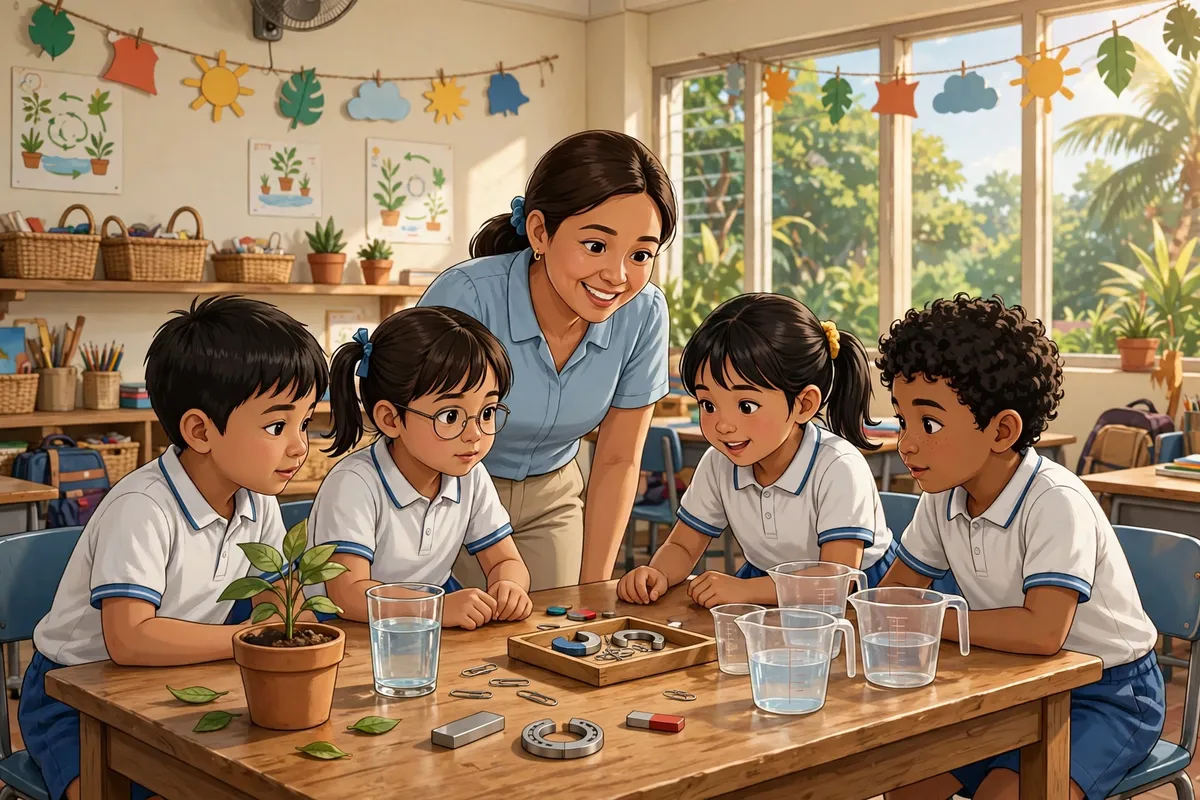
Science arrives gently. Learners observe, sort, describe, and ask questions. They learn that materials have properties, that living things grow and change, and that the sky and weather follow patterns. Teachers keep investigations short, hands-on, and safe — a glass of water with ice, a plant on the windowsill, a magnet and a pile of classroom objects. The skill being built is not vocabulary. It is attention: looking closely and saying what you actually see.
Grades 5–6: Measuring and investigating
Now the tools appear. A Grade 5 class studying states of matter learns to measure properly — milligrams, grams, and kilograms for mass, degrees Celsius for temperature — and to plan a simple investigation in steps instead of just watching a demo. Learners start using units correctly, recording results in tables, and explaining what changed and why. This is the bridge year: still concrete and hands-on, but with real measurement discipline.
Grades 7–8: Models, diagrams, and systems
Junior high Science gets more abstract, and the language changes with it. Grade 7 learners work with cells and reproduction in Life Science, and with heat and forces in the energy quarters — drawing free-body diagrams, telling heat apart from temperature, and explaining why heat flows from hot to cold. Grade 8 deepens the same domains with more complex systems. If your child suddenly brings home diagrams instead of drawings, that is the curriculum working as designed: models are how scientists think.
Grades 9–10: Abstract ideas and real debates
The final stretch is where Science meets society. Grade 10 centers on biodiversity and evolution, ecosystems, plate tectonics, and Earth’s resources — topics that connect directly to Philippine life, from conservation to disaster readiness. Upper-grade learners also tackle ideas that require judgment, not just recall: what limits an ecosystem’s carrying capacity, how natural selection drives change, and the environmental and ethical questions around biotechnology. A learner who can debate those questions with evidence has gotten what MATATAG Science is for.
For the full subject list around Science in a junior high year — including how many subjects a Grade 7 learner carries in total — see our guide to all subjects in Grade 7.
Science Time Allotment: Minutes Per Week
Science gets the same protected time at every grade it appears: 45 minutes a day, five days a week. That is 225 minutes per week, from Grade 3 all the way to Grade 10. No grade gets a double period, and no grade gets squeezed.
| Grade Band | Minutes Per Day | Days Per Week | Minutes Per Week |
|---|---|---|---|
| Grade 3 | 45 | 5 | 225 |
| Grades 4–6 | 45 | 5 | 225 |
| Grades 7–10 | 45 | 5 | 225 |
For context, that puts Science on equal footing with Filipino, English, Mathematics, and Araling Panlipunan in the upper grades. If you want every subject’s minutes side by side — including the NRP and NMP blocks that sit alongside Science in the elementary week — our MATATAG time allotment guide has the complete tables.
Science Topics Finder (Tool)
Pick a grade and see exactly which domain lands in each quarter, plus what that quarter focuses on. Use it when you plan lessons, check what your child is studying, or prepare for a transfer to a new school.

How Science Is Taught: Inquiry First
The guide is blunt about pedagogy: competencies “signal learning activities that require active learner participation using an inquiry approach.” In practice, that means a MATATAG Science lesson usually starts with a question or a phenomenon, not a definition. Why does ice melt faster in one cup than another? What happens to a plant kept in the dark? Learners predict, test, observe, and then explain — and the teacher’s job is to keep the explanation honest, not to hand it over in the first five minutes.
Two more ideas shape the classroom. The first is cross-cutting concepts — lenses that repeat across every domain, like patterns, cause and effect, systems, stability and change, and scale and measurement. A learner who spots a pattern in a weather chart and a pattern in a food web is using the same thinking tool twice. The second is connection across quarters: teachers are encouraged to link domains through the year rather than teaching each quarter as a sealed box. A lesson on ecosystems can borrow from Earth and Space; a lesson on materials can borrow from energy.
The guide also names newer methods teachers may use where they fit: design thinking and engineering design, robotics, mobile learning apps, games and gamification, and virtual or remote laboratories. Not every school has those tools, and the guide does not require them — but a teacher with one computer and a class set of phones can run a virtual lab, and a teacher with no equipment at all can still run an inquiry lesson with water, leaves, and sunlight. If you are building your own Science lessons from scratch, our MATATAG lesson plan guide shows how to structure one the MATATAG way, step by step.
What Changed From the Old K-12 Science
Teachers who taught the old curriculum notice the change immediately. Under the old K-12 Science, every year spiraled through all four disciplines — a bit of biology, a bit of chemistry, a bit of physics, a bit of earth science, every single year. MATATAG replaces that spiral with the domain-per-quarter structure above: one domain at a time, deeper, for a full quarter.
The second change is size. The old curriculum carried over 11,000 learning competencies across K-10; MATATAG cut that to roughly 3,600. Science felt that cut directly: fewer topics, more time per topic, and room for actual investigations instead of coverage sprints. A teacher who used to rush through a chapter in three days can now spend two weeks on one domain quarter and still finish the year.
The third change is the starting line. Old Science content reached down into the early grades in scattered form. MATATAG draws a clean line: no standalone Science in Grades 1 and 2, Science proper from Grade 3. Parents sometimes read that as “less Science.” It is actually the opposite trade: later start, but protected minutes, deeper quarters, and a full Grade 3 to 10 run with no gaps.
Tips for Teachers and Parents
- Plan by quarter, not by chapter. The domain table above is your year plan. If you know Quarter 1 is Materials, you can gather materials once and reuse them for weeks.
- Keep one inquiry routine. Predict, observe, explain — the same three steps every investigation. Learners get faster at real Science when the routine stops changing.
- Use the Philippines as the laboratory. Typhoons, volcanoes, rice fields, coral reefs, and jeepney traffic are all Science content. Local examples beat textbook examples every time.
- For parents: ask “what did you observe?” not “what did you memorize?” The first question matches how Science is now taught, and it tells you far more about what your child actually learned.
- Watch for transfer shock. A child who moves schools mid-year may land on a different domain quarter. A quick check with the new teacher — and the topics finder tool above — closes that gap fast.
- Download the official guide. The full DepEd Science CG is free online. Skim the quarter sequence first; the competency tables make much more sense once you see the pattern.
Frequently Asked Questions
When does Science start under MATATAG?
Science starts in Grade 3. Grades 1 and 2 have no standalone Science subject; they build the reading and math foundations that inquiry work depends on.
How many Science domains are there?
Four: Materials (Science of Materials in junior high), Force, Motion, and Energy, Living Things (Life Science in junior high), and Earth and Space (Earth and Space Science in junior high). One domain is assigned to each quarter.
Is the Science curriculum guide in science the same for all grades?
There is one official guide — “MATATAG Curriculum: Science (Grades 3-10)” — but the content inside is organized by grade and quarter, so each grade studies the four domains in its own sequence and depth.
How many minutes of Science per week?
225 minutes per week at every grade from 3 to 10: 45 minutes a day, five days a week.
Where can I download the official MATATAG Science curriculum guide?
DepEd publishes the guide as a free PDF on deped.gov.ph. The sources section below links to it directly.
What is the biggest difference from old K-12 Science?
The old curriculum spiraled through all four disciplines every year. MATATAG assigns one domain per quarter, with far fewer competencies overall — roughly 3,600 across K-10 instead of over 11,000 — so each domain gets real depth.
Conclusion
The MATATAG Science curriculum guide is simpler than it first looks: four domains, one per quarter, from Grade 3 to Grade 10, at 225 minutes a week, taught through inquiry rather than memorization. Once you know the quarter sequence, you can plan a lesson, follow your child’s year, or help a transferee catch up without guessing.
Teachers: start with the quarter table, build one steady inquiry routine, and let the Philippines itself supply your examples. Parents: ask what your child observed, not what they memorized — that is the question this curriculum is designed to reward. And if you want the quarter sequence and a planning checklist in one printable page, grab the free PDF below. For the complete subject picture across all grades, start at the MATATAG Curriculums homepage and follow the guides from there.
Sources & References
- DepEd — MATATAG Curriculum: Science (Grades 3-10) Curriculum Guide, August 2023 (PDF)
- DepEd Order No. 010, s. 2024 — Policy Guidelines on the Implementation of the MATATAG Curriculum
- Philippine News Agency — DepEd launches MATATAG Curriculum to address basic education woes (rollout schedule)