MATATAG TLE Curriculum Guide: What Teachers Need to Know (Grades 4–10)
Ask a room of teachers which MATATAG subject keeps them up at night, and you’ll hear TLE more than once. Not because it’s new — EPP and TLE have been part of Philippine classrooms for years. It’s the revised version that changed the game: fewer competencies, but sharper. Real tools in kids’ hands earlier. And a grading setup where the performance task — not the quiz — decides the grade. This MATATAG TLE curriculum guide covers Grades 4 to 10 end to end: the four components, how skills build across the key stages, the official time allotment, how grading actually works, and what to do when your classroom looks nothing like the fully equipped lab in the pictures.
First, the name — because it trips people up. In Grades 4 to 6 the learning area is called EPP (Edukasyong Pantahanan at Pangkabuhayan). From Grade 7 on, it becomes TLE (Technology and Livelihood Education). One family, one continuous line. DepEd’s MATATAG EPP/TLE curriculum guide treats Grades 4 through 10 as a single learning area, and the goal it states is refreshingly plain: give learners lifelong learning skills so they grow into productive people, ready for real work, able to pull their weight in the country’s goals.
Here’s what’s ahead: what EPP/TLE covers at each grade band, the four components up close, the skills-progression table teachers keep asking for, time allotment under the latest orders, the language rule nobody should get wrong, how the grading really works, the bridge to TVL in senior high, honest strategies for schools without full workshops, and straight answers to the questions teachers ask most.
What the MATATAG TLE Curriculum Guide Covers (and Why It’s One Subject)
The old K to 12 version of TLE sprawled. Four areas in junior high, exploratory courses schools picked almost freely, competencies that ran pages long. MATATAG kept the practical soul of the subject and rebuilt it as a ladder. DepEd’s description is simple enough to quote: EPP/TLE gives learners basic home and livelihood skills — the kind that make them productive in daily life, not just on test day.
Three rungs on that ladder. Grades 4 to 6: learners taste the fundamental home skills of four components — Information and Communications Technology (ICT), Agriculture and Fishery Arts (AFA), Family and Consumer Science (FCS), Industrial Arts (IA). A little coding, a little planting, a little cooking, a little woodwork. Every child walks away with basic life skills, whatever they specialize in later.
Grades 7 to 8: the tone shifts. Now it’s basic and common competencies — safety procedures, proper tool handling, the foundational techniques of each sector. Less tasting, more doing it right.
Grades 9 to 10: selected core competencies in every sector, with entrepreneurial skills turned up. The guide calls it “exploratory by sector.” Learners meet real industries of specialization: using tools and equipment, mensuration, reading drawings and plans, occupational safety and health, spotting career and business openings.
Who Takes EPP/TLE, and When the New Guides Kick In
EPP/TLE runs Grades 4 through 10. You won’t find it in Kindergarten to Grade 3 — MATATAG keeps the early grades on foundational literacy, numeracy, Makabansa, and GMRC. From Grade 4 it joins the eight learning areas of Key Stages 2 and 3, alongside Filipino, English, Math, Science, Araling Panlipunan, MAPEH, and GMRC/Values Education.
Rollout follows DepEd Order No. 010, s. 2024: Kinder, Grades 1, 4, and 7 went MATATAG in SY 2024–2025. Grades 2, 5, and 8 followed in SY 2025–2026. Grades 3, 6, and 9 shift in SY 2026–2027, and Grade 10 finishes the job in SY 2027–2028. Translation: Grade 4 has been on the new EPP guide for two school years already, while Grades 9 and 10 are the last in line. Teaching Grade 9 TLE this year? Probably your first year on the revised guide. Read it properly before the first quarter starts.
The Four Components: ICT, Agriculture, Home, and Industrial Arts
Same four components in every grade band. The rookie mistake is teaching only the one you personally enjoy — so here’s what each actually demands.
1. Information and Communications Technology (ICT)
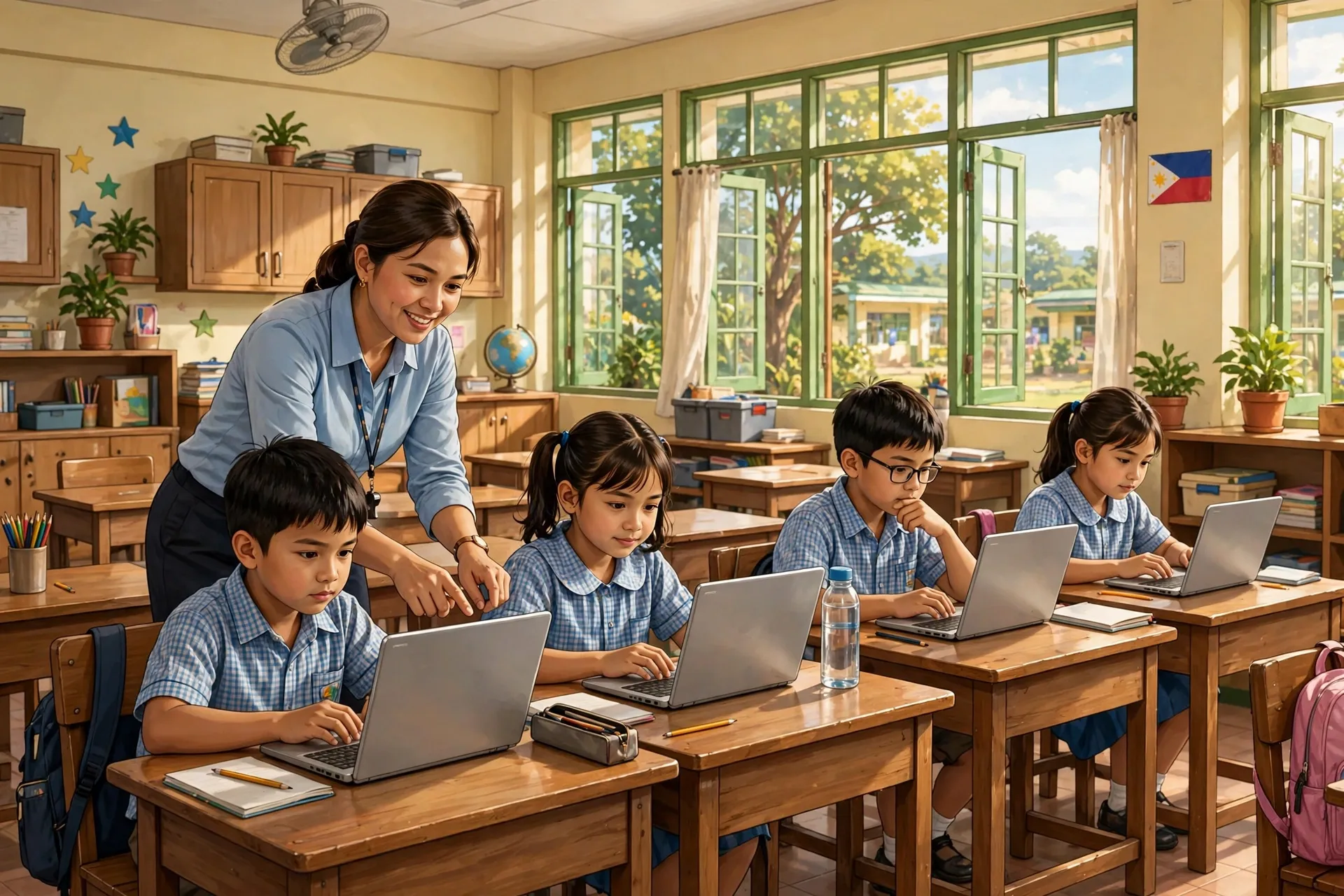
Forget computer theory. ICT here means practical digital literacy. Grades 4 to 6 start with block coding, productivity tools, and internet navigation — taught, the guide stresses, safely and responsibly. Grades 7 to 8 move to productivity tools for real outputs, plus graphic design and video editing. By Grades 9 to 10 the guide points at selected core competencies: Computer Systems Servicing, Computer Programming, Contact Center Services, Visual Arts. The through-line never changes — technology as a working tool, not something to memorize for a test.
2. Agriculture and Fishery Arts (AFA)
This one is rooted in a plain Philippine truth: food comes from somewhere. Early band means hands in the soil — ornamental plants, vegetables, fruit trees. The school garden work that never stopped working. Grades 7 and 8 add farm-operation safety and more systematic crop production. Grades 9 to 10 do agricultural practices in crop production using natural farming approaches. Near the coast? The fishery half of AFA carries equal weight — the component covers land and water livelihoods both.
3. Family and Consumer Science (FCS)
The home-management strand: food, clothing, shelter, and the consumer choices around them. Grades 4 to 6 cover fundamental home skills — basic food prep, basic home care. Grades 7 to 8 introduce common kitchen tools, occupational safety and health, and — this matters — career and business openings in food services, clothes construction, handicrafts, beauty care. Grades 9 to 10 sharpen into service-level skills: constructing different clothing styles, client care and support, food and beverage service. Of the four components, this is the one that most directly becomes a small business later.
4. Industrial Arts (IA)
The trades strand. Young learners build simple wood, bamboo, metal, or electrical projects — with strict safety precautions, always. Grades 7 to 8 learn to read the signs and symbols of wood/bamboo and metal construction, electrical services, automotive and small engine services. Grades 9 to 10 go applied: electrical installation done safely, for instance. This is where the guide’s “mensuration and interpreting drawings and plans” stops being jargon — read the plan, measure twice, cut once.
How Skills Progress: Grades 4–6, 7–8, and 9–10
Most teachers want this as a table, so here it is — one component, three bands, what actually changes:
| Component | Grades 4–6 (EPP): Fundamental home skills | Grades 7–8 (TLE): Basic & common competencies | Grades 9–10 (TLE): Selected core competencies |
|---|---|---|---|
| ICT | Block coding, productivity tools, safe internet navigation | Productivity tools, graphic design, video editing | Computer Systems Servicing, Computer Programming, Contact Center Services, Visual Arts |
| AFA | Natural planting: ornamentals, vegetables, fruit trees | Farm safety procedures, crop production practices | Agricultural practices in crop production; natural farming |
| FCS | Basic home management and food preparation | Kitchen tools, OSH, food services, clothes construction, handicrafts, beauty care | Clothing construction, client care and support, food & beverage service |
| IA | Simple wood/bamboo/metal/electrical projects with safety precautions | Signs and symbols: construction, electrical, automotive, small engine services | Applied procedures (e.g. electrical installation) with safety precautions |
See the pattern? Explore first, then practice safely, then produce at near-industry level. Nobody asks a Grade 4 pupil to wire a circuit, and no Grade 10 learner gets away with a coloring activity. Match your performance tasks to the band — most assessment headaches vanish on their own.
Time Allotment: TLE’s Place in the School Week
DepEd Order No. 010, s. 2024 puts EPP/TLE at 45 minutes a day, five days a week — same as the other core learning areas in Grades 4 to 10. Then DO 012, s. 2024 amended the picture after teachers’ groups pushed back on workload. Two floors from that amendment matter directly for TLE:
- English, Math, Science, GMRC/Values Education: not less than 225 minutes a week.
- EPP/TLE, MAPEH, Araling Panlipunan, Filipino: not less than 200 minutes a week.
Schools can also go uniform — 50, 55, or 60 minutes per learning area. Under that setup EPP/TLE runs four times a week while the 225-minute group stays at five. And a school that fits neither mold may propose its own combination, as long as daily learning contact time stays at five hours thirty minutes minimum, the minute floors hold, and the Schools Division Superintendent signs off. Bottom line: TLE keeps a solid weekly block in every legal configuration. It’s never the subject that gets squeezed to make room.
Filipino First, English After: The Language Rule
The guide is blunt about medium of instruction: Filipino for Grades 4 to 5, English from Grade 6 through Grade 10. It mirrors the wider MATATAG language policy — early grades use the language kids actually speak at home, then shift as the technical vocabulary of the trades demands it.
Where this bites: tool names, measurements, safety instructions. A Grade 4 EPP lesson on kitchen tools lands better in Filipino — “sandok,” “kawali” — because those are the words children hear at home. By Grade 9, that same learner should be reading an electrical plan or a sewing pattern in English, because that’s the language of the TESDA training regulations and industry manuals waiting in senior high. Make the switch deliberately at Grade 6. Don’t drift into it.
Entrepreneurship Isn’t a Separate Lesson
Here’s one of the sharpest moves in the MATATAG EPP/TLE guide: entrepreneurship is woven through all four components, not parked in its own unit. It intensifies in Grades 9 and 10, but the seed goes in early — costing recipe ingredients in FCS, pricing seedlings from the class garden in AFA, quoting a simple carpentry job in IA.
Think mindset, not business-plan template. Again and again learners have to connect a skill to a livelihood: who pays for this, what does it cost to make, can I do it safely and well enough to charge for it. That’s also why “career and business opportunities” shows up in the upper band’s description — by Grade 10, a learner should look at any of the four components and name real jobs and real small businesses attached to it.
Assessment: Why Performance Tasks Carry the Grade
Same DepEd Order No. 8, s. 2015 rules as every subject. But the weights are what set TLE apart — EPP/TLE sits in the cluster with the heaviest performance-task weight in the entire curriculum:
| Component (Grades 1–10) | Weight |
|---|---|
| Written Works (quizzes, long tests, reports) | 20% |
| Performance Tasks (skills demonstration, projects, outputs) | 60% |
| Quarterly Assessment | 20% |
Sixty percent on performance. Let that reshape your quarter planning: the project is the grade. A learner who aces every quiz but can’t demonstrate the skill is missing the subject’s whole point. Build the performance tasks first — the dish cooked to standard, the program that actually runs, the seedling bed kept alive for a month, the project built to measurement — then let written works and the quarterly test play support. For the full computation with a worked example, see our guide on how grades are computed in the MATATAG grading system.
Two habits pay off specifically in TLE. First, rubrics — shared before the work begins. Measurement accuracy, safety compliance, finish quality: none of it is arguable when it’s been on paper since day one. Second, evidence. Photos of the process and the finished product protect you and the learner when a grade gets questioned, and they double as portfolio material.

After Grade 10: The Bridge to TVL and TESDA
Junior-high TLE is, by design, the on-ramp to the Technical-Vocational-Livelihood (TVL) track in senior high. The guide doesn’t hide it: TVL is where the technical skills live, and in Grades 11 to 12 learners pick a specialization tied to TESDA Training Regulations — the national competency standards behind real qualifications like NC I and NC II.
Which is exactly why Grades 9–10 carry so much weight. That exploratory-by-sector work — Computer Systems Servicing, food and beverage service, electrical installation, crop production — maps straight onto TESDA qualification titles. A learner who took the four components seriously from Grade 7 walks into senior high already knowing which sector fits, with hands-on habits (tool care, OSH, measurement) that most SHS entrants are still picking up. When parents ask what TLE is “for,” that’s the honest answer: the first half of a vocational pathway that ends in a national certificate.
Teaching TLE When the Lab Isn’t Ready
Time for honesty about the hardest part. The guide assumes tools, materials, and workspaces that plenty of schools only half-have. The curriculum still works — but it takes deliberate adaptation, not wishful thinking.
- Teach the skill, improvise the station. Mensuration doesn’t need a machine shop. A meter stick, a piece of lumber, and a cutting list teach the same competency as a workbench. Food prep scales down to one-burner setups and group rotations.
- Rotate, don’t wait. One tool set for forty learners? Run stations. One group measures, one sketches the plan, one does the costing sheet, one executes. Everybody touches every station by week’s end — and the costing sheet quietly teaches the entrepreneurship strand.
- Use the community as your laboratory. The sari-sari store owner explains pricing better than any module. A local carpenter, farmer, or seamstress demonstrating for one period gives learners a real practitioner to copy — and it costs nothing.
- Make safety non-negotiable. With improvised equipment, occupational safety and health stops being a lesson topic and becomes classroom management. Demonstrate, drill, enforce safe handling every single session. Assess it inside the performance rubric.
- Document everything with a phone camera. Process photos are assessment evidence, portfolio artifacts, and your defense if anyone questions a grade. They also let learners review their own technique.
Building your first TLE lesson plans under the new guide? Our step-by-step walkthrough of the MATATAG lesson plan format uses a worked example — swap in your TLE competencies and performance task and you’re most of the way there.
Frequently Asked Questions
Is EPP the same subject as TLE?
One continuous learning area, two names by grade band: EPP (Edukasyong Pantahanan at Pangkabuhayan) in Grades 4 to 6, TLE (Technology and Livelihood Education) in Grades 7 to 10. DepEd’s MATATAG guide covers both in a single document.
What are the four components of EPP/TLE in the MATATAG curriculum?
Information and Communications Technology (ICT), Agriculture and Fishery Arts (AFA), Family and Consumer Science (FCS), Industrial Arts (IA). Every band works through all four — what changes is depth: fundamental home skills in 4–6, basic and common competencies in 7–8, selected core competencies per sector in 9–10.
How many minutes per week is TLE under MATATAG?
DepEd Order No. 010, s. 2024: 45 minutes a day, five days a week. The amendment (DO 012, s. 2024) guarantees EPP/TLE not less than 200 minutes a week, alongside MAPEH, Araling Panlipunan, and Filipino.
What is the grading breakdown for TLE?
Under DepEd Order No. 8, s. 2015: Written Works 20%, Performance Tasks 60%, Quarterly Assessment 20%. The performance task — the demonstrated skill itself — carries the heaviest weight of any subject cluster.
What language is used to teach EPP/TLE?
Filipino in Grades 4 to 5, English from Grade 6 through Grade 10, following the MATATAG language policy for the learning area.
Do Grades 9 and 10 learners specialize in just one TLE sector?
Not quite. Grades 9–10 take selected core competencies in every sector — “exploratory by sector” — with entrepreneurial skills intensified. The point is informed choice before TVL’s real specialization in senior high.
What comes after TLE in senior high school?
The Technical-Vocational-Livelihood (TVL) track in Grades 11–12: a chosen specialization aligned with TESDA Training Regulations, leading to national certifications (NC I / NC II).

Conclusion
TLE under MATATAG is easier to describe than it used to be and harder to fake. Four components. Three bands of rising skill. Performance tasks that decide the grade. A straight road into TVL and TESDA certification. Get the structure right — explore in 4–6, practice safely in 7–8, produce at near-industry level in 9–10 — and the subject nearly plans itself. This week: check which band your learners are actually in, match your performance tasks to it, and make safety and evidence part of every session. Tools can be improvised. Structure can’t.
Sources & References
- DepEd Order No. 010, s. 2024, “Policy Guidelines on the Implementation of the MATATAG Curriculum” — official PDF at deped.gov.ph
- DepEd, MATATAG Curriculum: Edukasyong Pantahanan at Pangkabuhayan (EPP) / Technology and Livelihood Education (TLE), Grades 4–10 — shaping paper and curriculum guides (2023)
- DepEd Order No. 012, s. 2024, amendment to DO 010 s. 2024 (flexible time allotment guidelines), as reported by the Philippine Daily Inquirer
- DepEd Order No. 8, s. 2015, “Policy Guidelines on Classroom Assessment for the K to 12 Basic Education Program” (component weights)