What Is the Proposed Airtime for Key Stage 1? The MATATAG Minutes Explained (2026)
A Grade 1 teacher in Quezon City once told me about her first week with a MATATAG class program. She had the timetable in front of her, five subjects at 40 minutes each, plus reading and math programs squeezed in around them, and one question kept nagging her: how many minutes is each subject actually supposed to get? She had heard older teachers call it “airtime” — the minutes a subject owns on the school day — and she wanted the official numbers, not guesses.
If you have asked the same thing, here is the straight answer. What is the proposed airtime for Key Stage 1? It is the set of minutes per subject that the Department of Education (DepEd) proposed for Kindergarten to Grade 3 under the MATATAG Curriculum, written into DepEd Order No. 010, s. 2024. Kindergarten runs on 180 minutes a day. Grades 1 and 2 run on 40-minute subjects. Grade 3 steps up to 45 minutes and adds Science. This guide lays out every number, the weekly totals, why the minutes change from grade to grade, and when a school is allowed to adjust them.
Download the free Key Stage 1 Airtime Checklist (PDF)
Key Stage 1 Airtime Checker (Tool)
Pick a grade level and see its full proposed airtime — every subject, its daily minutes, how many days a week it runs, and the weekly total.
What “Proposed Airtime” Actually Means
First, a small honesty note. You will not find the word “airtime” inside DepEd Order No. 010, s. 2024. The order calls these numbers “time allotments.” Teachers started saying “airtime” because it paints the picture better: every subject gets its own slot on the air, its own minutes on the timetable, and when one subject runs long, another one loses its turn.
The word “proposed” matters just as much. The minutes in this guide are DepEd’s proposed defaults — the starting point every public school builds its class program from. They are not carved in stone. DepEd Order No. 012, s. 2024 gave schools room to adjust them, with rules and a division approval attached. We will get to those rules later in this guide. But for most schools, the proposed numbers below are the numbers on the actual timetable.
One more thing to settle before the tables. Key Stage 1 means Kindergarten, Grade 1, Grade 2, and Grade 3. That is the definition in DepEd Order No. 010, s. 2024, and it is also how our Key Stage 1 guide explains the stage. In school year 2026–2027, all four of these grade levels are now running on the MATATAG Curriculum: Kindergarten and Grade 1 started in 2024–2025, Grade 2 followed in 2025–2026, and Grade 3 joined this school year. So the numbers below are live numbers, not future plans.
Key Stage 1 Proposed Airtime at a Glance
If you only need the big picture, this is it. Each grade’s day is built from its subjects, plus the National Reading Program (NRP), the National Mathematics Program (NMP), and the Homeroom Guidance Program (HGP) on top.
| Grade level | Minutes per day (Mon–Thu) | Minutes per day (Friday) | Minutes per week |
|---|---|---|---|
| Kindergarten | 180 | 180 | 900 |
| Grade 1 | 260 | 240 | 1,280 |
| Grade 2 | 260 | 240 | 1,280 |
| Grade 3 | 330 | 315 | 1,635 |
Notice the pattern. The school day grows with the child. A kindergartner is in class for 3 hours. A Grade 1 pupil stays 4 hours and 20 minutes Monday to Thursday. By Grade 3, the day is 5 hours and 30 minutes. That growth is deliberate: older children can handle longer lessons, and Grade 3 carries one more subject than Grades 1 and 2. Our full K-to-10 time allotment guide shows how the same pattern continues into Grades 4 to 10, where most subjects sit at 45 minutes.
Kindergarten: 180 Minutes of Blocks of Time
Kindergarten does not have subjects the way Grade 1 does. It has blocks of time, and the whole day adds up to 180 minutes, or 3 hours. The day is built around play, stories, and routines, not sit-down lessons. That is why the blocks have names like Circle Time and Wrap-Up Time instead of subject names.
| Block of time | Minutes | What happens |
|---|---|---|
| Meeting Time | 15 | Routines, greetings, and getting settled for the day |
| Circle Time 1 | 45 | Story read-aloud or picture reading, valuing, and processing |
| Supervised Recess | 15 | Guided break and snack time |
| Quiet / Nap Time | 10 | Rest after the morning’s activities |
| Circle Time 2 | 40 | Activities tied to the story: language, math, science, music, movement, and arts and crafts |
| Indoor / Outdoor Play | 35 | Free and guided play, inside or outside |
| Wrap-Up Time | 20 | Reviewing the day and closing routines |
| Total | 180 | 3 hours a day, 900 minutes a week |
Parents sometimes worry that 3 hours looks short next to an older child’s day. It is short on purpose. Five-year-olds learn through play and short, focused bursts, and a longer day would tire them out without teaching them more. If you want the full picture of what kindergarten covers, our kindergarten curriculum guide walks through the seven developmental domains behind these blocks.
Grade 1: Five Subjects at 40 Minutes
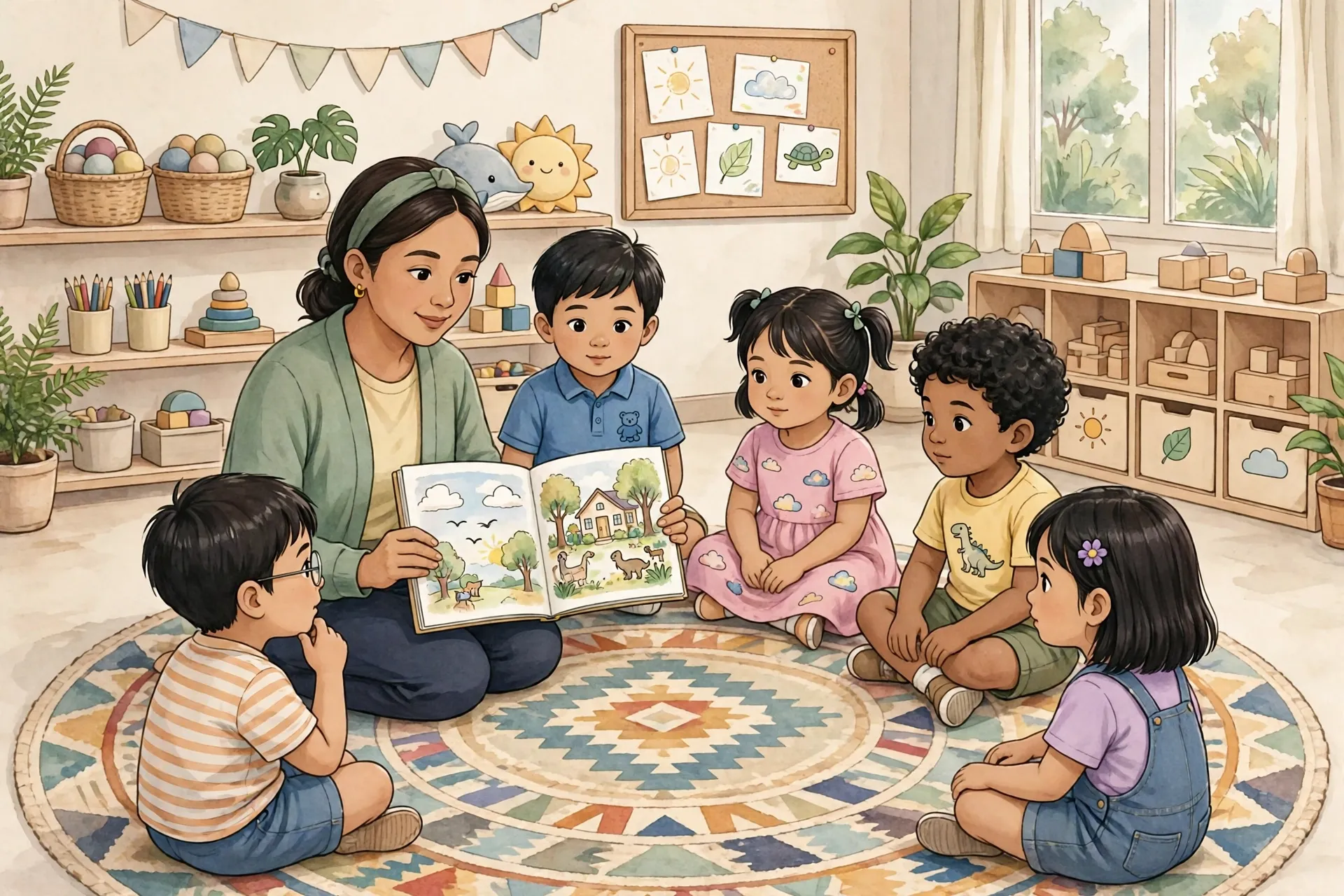
Grade 1 is where subjects begin, and there are only five of them. Each one gets 40 minutes a day, five days a week. That is 200 minutes per subject per week. On top of the five subjects, every Grade 1 pupil gets the National Reading Program and the National Mathematics Program, 30 minutes each, four times a week, plus one 40-minute Homeroom Guidance session.
| Learning area / program | Minutes per day | Days per week | Minutes per week |
|---|---|---|---|
| Language | 40 | 5 | 200 |
| Reading and Literacy | 40 | 5 | 200 |
| Mathematics | 40 | 5 | 200 |
| Makabansa | 40 | 5 | 200 |
| GMRC (Good Manners and Right Conduct) | 40 | 5 | 200 |
| National Reading Program (NRP) | 30 | 4 | 120 |
| National Mathematics Program (NMP) | 30 | 4 | 120 |
| Homeroom Guidance Program (HGP) | 40 | 1 | 40 |
| Total | 260 (Mon–Thu) / 240 (Fri) | 1,280 |
Two things stand out here. First, Grade 1 does not have Filipino and English as separate subjects yet. It has Language, and it has Reading and Literacy. The split into Filipino and English comes in Grade 2. Second, reading gets double protection: 40 minutes of Reading and Literacy every day, plus 120 more minutes of NRP every week. DepEd built it that way because Grade 1 is where reading either takes root or falls behind, and the extra minutes are the safety net.
The Friday total is a little lower — 240 instead of 260 — because the NRP and NMP sessions run Monday to Thursday, while the Friday slot goes to Homeroom Guidance. When you build a class program, that Friday difference is the detail most often missed, so check it twice. Our lesson plan guide shows how these daily minutes turn into actual lesson plans.
Grade 2: Filipino and English Arrive
Grade 2 keeps the exact same minute pattern as Grade 1. The only change is in the subject names. Language becomes Filipino, and Reading and Literacy becomes English — or, more precisely, the language work splits into two subjects, one for each language. The minutes do not change at all: still 40 minutes per subject, five days a week, with the same NRP, NMP, and HGP support on top.
| Learning area / program | Minutes per day | Days per week | Minutes per week |
|---|---|---|---|
| Filipino | 40 | 5 | 200 |
| English | 40 | 5 | 200 |
| Mathematics | 40 | 5 | 200 |
| Makabansa | 40 | 5 | 200 |
| GMRC (Good Manners and Right Conduct) | 40 | 5 | 200 |
| National Reading Program (NRP) | 30 | 4 | 120 |
| National Mathematics Program (NMP) | 30 | 4 | 120 |
| Homeroom Guidance Program (HGP) | 40 | 1 | 40 |
| Total | 260 (Mon–Thu) / 240 (Fri) | 1,280 |
This is the year parents sometimes ask why their child has two language subjects instead of one. The answer is simple: Grade 1 built the foundation in one combined language block, and Grade 2 starts teaching the two languages as their own subjects, each with its own reading, writing, and oral language work. The total language time stays the same — 400 minutes a week across the two — but it is now split evenly between Filipino and English.
Grade 3: The Jump to 45 Minutes — and Science Joins
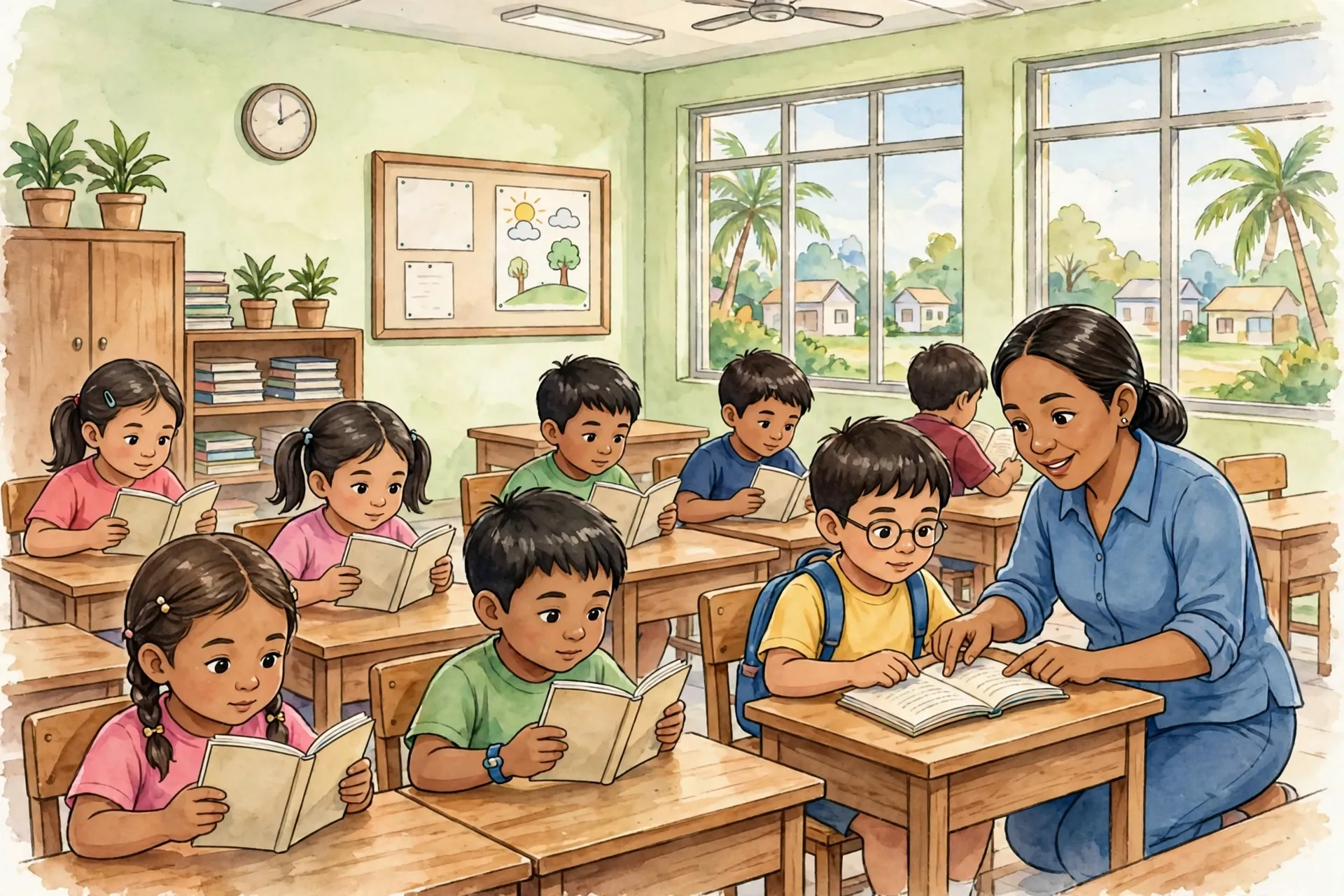
Grade 3 is where the timetable visibly grows. Every subject moves from 40 minutes to 45, and Science joins the list for the first time. That is six subjects at 45 minutes, five days a week — 225 minutes per subject per week, and 1,350 minutes of subject time in total. The NRP and NMP stay at 30 minutes four times a week, and Homeroom Guidance steps up to 45 minutes once a week.
| Learning area / program | Minutes per day | Days per week | Minutes per week |
|---|---|---|---|
| Filipino | 45 | 5 | 225 |
| English | 45 | 5 | 225 |
| Mathematics | 45 | 5 | 225 |
| Makabansa | 45 | 5 | 225 |
| GMRC (Good Manners and Right Conduct) | 45 | 5 | 225 |
| Science | 45 | 5 | 225 |
| National Reading Program (NRP) | 30 | 4 | 120 |
| National Mathematics Program (NMP) | 30 | 4 | 120 |
| Homeroom Guidance Program (HGP) | 45 | 1 | 45 |
| Total | 330 (Mon–Thu) / 315 (Fri) | 1,635 |
The jump from 1,280 to 1,635 minutes a week — an extra 355 minutes, almost six hours — is the biggest single-year increase in all of Key Stage 1. It happens for two reasons. Science adds 225 minutes on its own, and the extra five minutes on each of the five older subjects adds 125 more. Grade 3 is also the bridge year: it is the last year of Key Stage 1, and its 45-minute subjects match the rhythm pupils will meet in Grade 4, where the same 45-minute pattern continues across more subjects.
One practical note for class programmers: Friday in Grade 3 is 315 minutes, not 330, because the NRP and NMP sessions sit on Monday to Thursday and Friday carries the Homeroom Guidance session instead. The same Friday pattern holds in Grades 1 and 2, just with smaller numbers.
Can a School Change the Proposed Airtime?
Yes, but not freely. DepEd Order No. 012, s. 2024 — the flexibility order — lets schools adjust the class program when the default setup does not fit their staffing, classrooms, or shifting schedules. It gives three options, and every school program still needs to land on one of them.
- Option A — keep the proposed numbers. This is the default: the minutes in the tables above, exactly as DepEd Order No. 010, s. 2024 sets them. Most schools use this one.
- Option B — uniform longer periods. A school may set every learning area to the same length — 50, 55, or 60 minutes — instead of the mixed 40- and 45-minute pattern. Core subjects still have to run five times a week, and the rest at least four times, with Homeroom Guidance once a week.
- Option C — propose another combination. If neither option fits, a school may propose its own mix, but three floors apply: total learning contact time of at least 5 hours and 30 minutes a day, core subjects at no less than 225 minutes a week, other learning areas at no less than 200 minutes a week, and Homeroom Guidance at no less than 45 minutes a week. The proposal needs the approval of the Schools Division Superintendent or an authorized representative.
For Key Stage 1, the practical point is this: the proposed airtime in this guide is the starting point, and any change goes through the division office. A parent who sees a timetable that looks different from these tables is not necessarily looking at a mistake — the school may be running an approved Option B or C schedule. But a timetable that cuts a subject below the weekly floors, or drops reading or math time to make room for something else, is worth asking about.
What This Means for Teachers and Parents
For teachers, the tables above are the raw material of the class program. Start from the proposed minutes, lay out Monday to Thursday first, then fit Friday around the Homeroom Guidance session. Guard the reading and math program minutes: the NRP and NMP are easy to squeeze when the week gets crowded, but they are the reason Grades 1 and 2 carry 240 extra minutes a week of reading and math support. If your school runs double shifts or shares classrooms, talk to your school head early — that is exactly the situation DepEd Order No. 012, s. 2024 was written for, and an approved adjustment beats a timetable that quietly drops minutes.
For parents, the numbers answer a simpler question: how long is my child’s school day, and what fills it? A kindergartner’s 3-hour day is mostly stories, play, and routines. A Grade 1 or 2 pupil spends a little over 4 hours in class, with reading and math getting the biggest share of protected time. A Grade 3 pupil’s day stretches past 5 hours because Science joins and every subject grows by five minutes. If your child’s timetable looks very different from these numbers, ask the school which flexibility option it is running — the answer should be Option A, B, or C, not a shrug.

Frequently Asked Questions
What is the proposed airtime for Key Stage 1?
It is DepEd’s proposed weekly minutes per subject for Kindergarten to Grade 3 under the MATATAG Curriculum: 900 minutes a week in Kindergarten, 1,280 minutes a week in Grades 1 and 2, and 1,635 minutes a week in Grade 3. The figures come from the time allotment tables in DepEd Order No. 010, s. 2024.
How many minutes per subject does Grade 1 get?
Each of the five Grade 1 subjects — Language, Reading and Literacy, Mathematics, Makabansa, and GMRC — gets 40 minutes a day, five days a week, or 200 minutes a week. The NRP and NMP add 120 minutes each per week, and Homeroom Guidance adds 40 minutes.
Why is Kindergarten only 180 minutes a day?
Kindergarten runs on blocks of time built around play, stories, and routines rather than subjects, and 3 hours matches what five-year-olds can handle in a focused day. The blocks — Meeting Time, two Circle Times, recess, nap time, play, and wrap-up — add up to exactly 180 minutes.
Is the airtime the same in every school?
Not always. DepEd Order No. 012, s. 2024 lets schools use uniform 50-, 55-, or 60-minute periods (Option B) or propose their own combination (Option C) when the default schedule does not fit. Any change must respect weekly minimums and, for Option C, needs division superintendent approval.
When did Grade 3 join the MATATAG Curriculum?
Grade 3 joined in school year 2026–2027, the third phase of the rollout. Kindergarten and Grade 1 started in 2024–2025, and Grade 2 followed in 2025–2026. So this school year is the first in which the whole of Key Stage 1 runs on MATATAG.
What are the NRP, NMP, and HGP?
NRP is the National Reading Program, NMP is the National Mathematics Program, and HGP is the Homeroom Guidance Program. In Key Stage 1, the NRP and NMP each run 30 minutes four times a week, giving struggling readers and young mathematicians extra guided time on top of their regular subjects. The HGP runs once a week and covers values, study habits, and personal guidance.
Conclusion
The proposed airtime for Key Stage 1 is not a mystery once you see it laid out: 180 minutes a day in Kindergarten, 40-minute subjects in Grades 1 and 2, and 45-minute subjects plus Science in Grade 3, with reading and math programs layered on top in every grade. The minutes grow with the child, and they grow for a reason — longer lessons and one more subject each step of the way.
Teachers can use these tables as the backbone of a class program, and parents can use them to check that their child’s timetable gives reading and math the time DepEd intended. If your school adjusts the numbers, the adjustment should still be visible, explained, and approved — that is what the flexibility rules are for.
For the bigger picture, start at the MATATAG Curriculum, where every guide, tool, and free download on this site is collected in one place.
Sources & References
- DepEd Order No. 010, s. 2024 — Policy Guidelines on the Implementation of the MATATAG Curriculum (Annex 1: Elementary Education, Time Allotment tables for Kindergarten, Grades 1, 2, and 3)
- DepEd Order No. 012, s. 2024 — Amendment to DepEd Order No. 010, s. 2024 (flexibility options for class programs)
- DepEd Order No. 009, s. 2024 — Implementing Guidelines on the School Calendar and Activities for SY 2024–2025 (phased implementation schedule)
- Inquirer.net, “DepEd issues new guidelines for Matatag Curriculum implementation” (September 19, 2024) — Options A, B, and C under DO 012, s. 2024
- Manila Bulletin, “‘Flexible’ MATATAG Curriculum guidelines set for implementation in Q2 of SY 2024–2025” (September 19, 2024)
- Official DepEd website: deped.gov.ph