Key Stage 1 DepEd Explained: Kindergarten to Grade 3 Under MATATAG (2026 Guide)
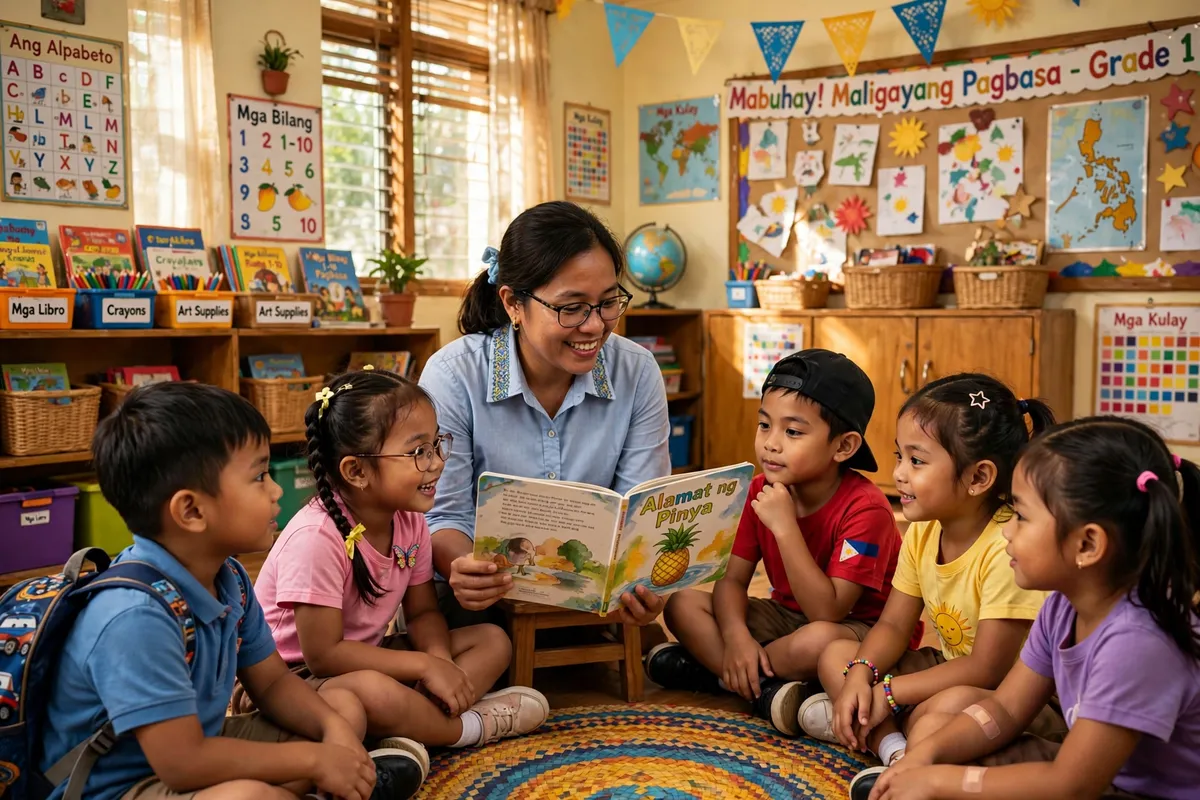
At enrollment, a father stared at the school form and frowned. Under his daughter’s grade level, it said “Key Stage 1.” He asked the registrar what it meant. She smiled and said, “Ibig sabihin po, nasa unang yugto siya — Kindergarten hanggang Grade 3. Dito po nabubuo ang pagbasa at pagbilang.”
If you’ve seen the same term and wondered what it actually covers, here’s the plain explanation. Key Stage 1 DepEd means the first stage of basic education under the MATATAG Curriculum: Kindergarten, Grade 1, Grade 2, and Grade 3. It’s the stage where children learn to read, write, and count — and DepEd itself calls these the most critical years of schooling. This guide explains which subjects each grade takes, how reading develops across the stage, what the NRP and NMP programs do, and what changed from the old curriculum. There’s a small checker tool and a free parent checklist at the end.
Free Download: Key Stage 1 Parent Guide Checklist (PDF)
One page: KS1 grades and subjects, the three reading stages, NRP/NMP explained, and home tips — with checkboxes for tracking.
Download the Key Stage 1 Parent Guide Checklist (PDF)
Key Stage 1 Subjects Checker (Tool)
Pick your child’s grade level and see exactly what Key Stage 1 covers at that level — subjects, reading stage, and focus.
What Is Key Stage 1 in DepEd?
DepEd divides basic education into key stages — blocks of grade levels that share one focus. Key Stage 1 (KS1) is the first block: Kindergarten through Grade 3. Its entire job is foundations: literacy, numeracy, and values. Everything after KS1 — the eight subjects of Grades 4 to 6, the specializations of high school — assumes these foundations are already in place.
Here’s the stage at a glance:
| Grade | Learning Areas | Count |
|---|---|---|
| Kindergarten | Play-based developmental domains (not formal subjects) | 6 domains |
| Grade 1 | Language, Reading and Literacy, Mathematics, Makabansa, GMRC | 5 |
| Grade 2 | Filipino, English, Mathematics, Makabansa, GMRC | 5 |
| Grade 3 | Filipino, English, Mathematics, Science, Makabansa, GMRC | 6 |
Notice the pattern: the load grows slowly. Grade 1 has five areas, Grade 2 has five, Grade 3 adds Science to make six. Then Grade 4 jumps to eight. That gentle ramp is deliberate — KS1 is about depth, not volume. A child who reads fluently by Grade 3 will handle eight subjects in Grade 4. A child who doesn’t will struggle in all eight at once. If you want to see how the later stages build on this, our MATATAG time allotment guide lays out every grade level the same way.
Why Key Stage 1 Matters Most
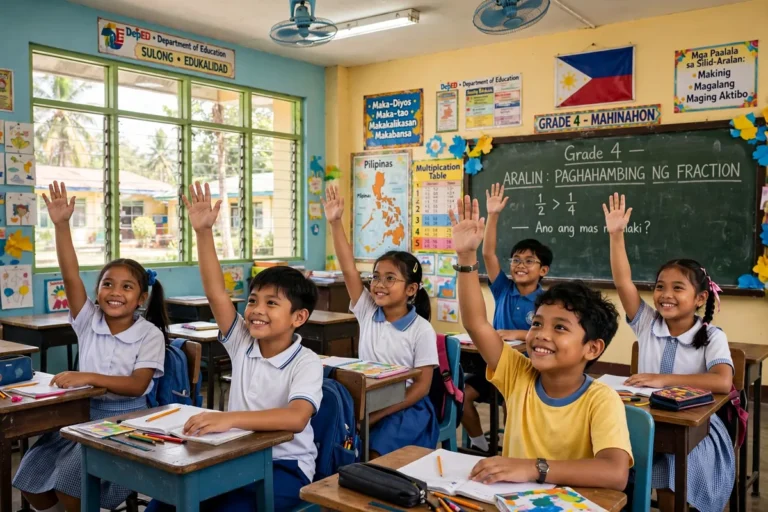
Teachers have a saying: “Grade 3 is the deadline.” It sounds harsh, but the research behind it is simple. Children spend Kindergarten to Grade 3 learning to read. From Grade 4 on, they read to learn — textbooks, word problems, science instructions all assume reading is already automatic. A learner who still struggles to read in Grade 4 doesn’t just struggle in English class; they struggle in every subject that uses text, which is nearly all of them.
That’s why DepEd poured so much of the MATATAG reform into this stage: fewer subjects in the early grades (five instead of seven), more time for reading and math, and two dedicated support programs — the National Reading Program (NRP) and the National Mathematics Program (NMP) — running alongside regular classes. The whole point of Key Stage 1 DepEd is to make sure no child leaves Grade 3 without the two skills everything else depends on: reading and counting.
Subjects in Key Stage 1, Grade by Grade
Each grade in KS1 looks different, because each one has a different job. Here’s the breakdown teachers use:
Kindergarten: Learning Through Play
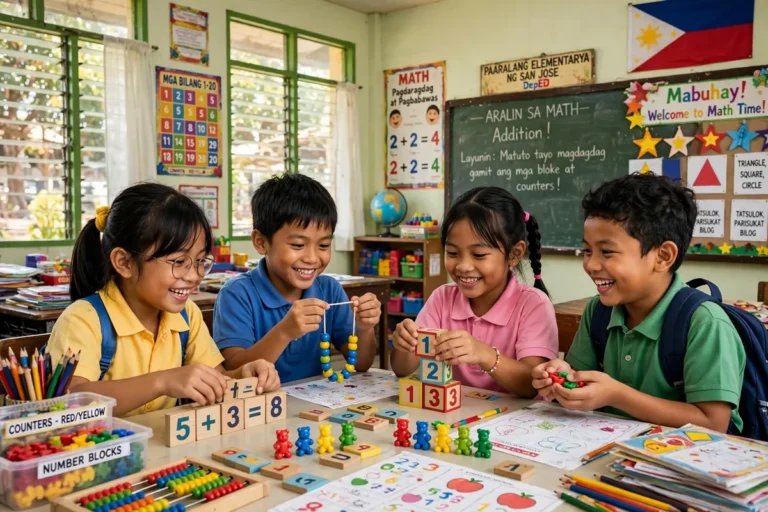
Kindergarten has no formal subjects. Instead, learning happens through play across six developmental domains: socio-emotional development, values development, aesthetic and creative development, physical health and motor development, language, literacy and communication development, and cognitive development. A child sorting colored blocks is learning math. A child telling a story to classmates is learning language. The play IS the lesson — and DepEd is explicit that formal subjects only begin in Grade 1.
Grade 1: Five Learning Areas
Grade 1 is where formal schooling starts, with five areas: Language, Reading and Literacy, Mathematics, Makabansa, and GMRC. Two things stand out. First, Language and Reading and Literacy are separate subjects — one builds oral fluency in the language the child actually speaks, the other builds reading itself. Second, there is no separate Mother Tongue subject anymore; the child’s own language is used as the medium of teaching, and teachers have flexibility on which language to use in Grade 1. Our Makabansa curriculum guide explains the Makabansa subject in detail for Grades 1 to 3.
Grade 2: Five Learning Areas
Grade 2 keeps five areas, but the language subjects split: Language becomes Filipino and English as separate subjects. So Grade 2 takes Filipino, English, Mathematics, Makabansa, and GMRC. Reading work shifts from “learning the letters” to reading real texts with understanding — and the NRP and NMP support programs run alongside.
Grade 3: Six Learning Areas
Grade 3 adds Science, making six: Filipino, English, Mathematics, Science, Makabansa, and GMRC. Science here is gentle — observing, classifying, asking questions about the natural world — but it’s the first step toward the full Science subject of Grades 4 and up. By the end of Grade 3, a learner should read fluently, compute confidently, and be ready for the eight-subject jump of Grade 4.
That grade-by-grade ladder is the core of Key Stage 1 DepEd — five areas, then five, then six.
The Three Reading Stages
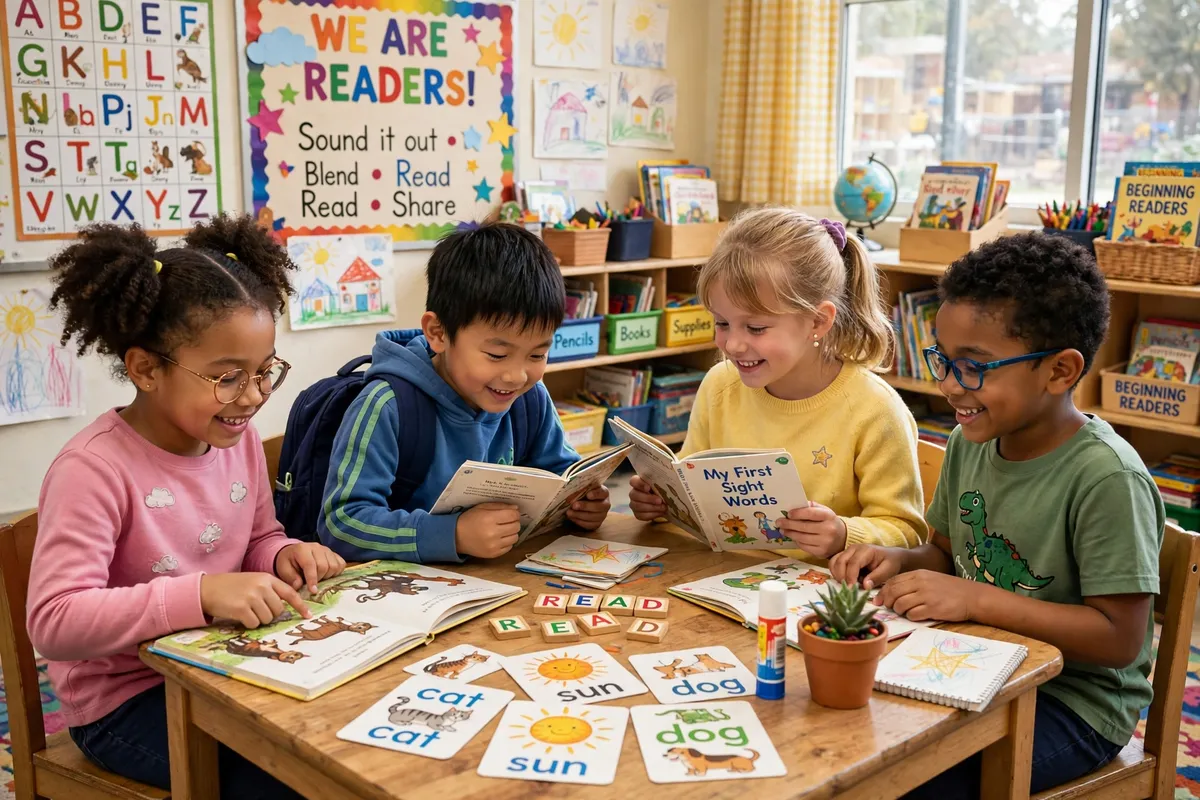
Reading doesn’t develop all at once in KS1. DepEd’s framework names three stages, and knowing them helps parents understand what “progress” should look like:
| Stage | Grade | What It Looks Like |
|---|---|---|
| Emergent literacy | Kindergarten | Listening to stories, recognizing letters, playing with sounds and rhymes, pretending to read |
| Beginning reading | Grade 1 | Sounding out words, reading short texts, building phonics and vocabulary, writing simple sentences |
| Rapid growth | Grades 2–3 | Reading longer texts fluently, understanding main ideas, discussing stories, writing with more structure |
The goal by the end of KS1: learners who can use their conversational language in daily life AND their academic language to understand and discuss lesson content — in texts that are roughly 70% stories and 30% informational. Fluency matters as much as accuracy: DepEd emphasizes reading accurately, quickly, smoothly, and with proper expression, not just getting the words right. Teachers planning KS1 lessons can match activities to these stages using our MATATAG lesson plan guide.
NRP and NMP in Key Stage 1
Two support programs run through all of KS1, and parents hear their initials constantly. Here’s what each one does:
| Program | Full Name | What It Does in KS1 |
|---|---|---|
| NRP | National Reading Program | Reading intervention and enhancement — the backbone of Catch-up Fridays’ first half; makes sure every child reads well |
| NMP | National Mathematics Program | Math intervention blocks (Grades 1–3: 5 weeks, 3 days/week, 90 minutes/day) with Rapid Mathematics Assessment before and after |
Both sit under the National Learning Recovery Program, and both work the same way: assess first, group by need, teach the specific missing skill, then re-check. Neither is a subject and neither has a grade. If your child’s teacher mentions either program, it means the school is giving targeted help — not labeling your child. Grades in KS1 still follow the regular system, which our MATATAG grading guide explains step by step.
What Changed from the Old Curriculum?
Parents who went through the old system notice three big differences in KS1:
| What | Old K to 12 (KS1) | MATATAG (KS1) |
|---|---|---|
| Number of areas (Grades 1–2) | 7 learning areas | 5 learning areas |
| Mother Tongue | Separate subject | No longer a subject; used as medium of instruction |
| New subject | — | Makabansa (identity, community, culture) |
| Values | EsP (Edukasyon sa Pagpapakatao) | GMRC (separate subject, RA 11476) |
| Support programs | Scattered remediation | NRP + NMP built into the system |
The practical effect: fewer things to juggle, more time per thing. A Grade 1 learner under the old system carried seven subjects; under MATATAG they carry five, and two of those five (Language and Reading and Literacy) are both about the same goal — learning to read well. That’s the whole philosophy of Key Stage 1 DepEd in one sentence: do fewer things, but do the foundational ones properly.
That philosophy — fewer things, done properly — is what makes Key Stage 1 DepEd different from the old system.
What Parents Can Do at Home
KS1 is the stage where home matters most, because the skills are small and daily:
Read together every day — even 10 minutes. It doesn’t have to be a lesson. A story before bed, a sign read aloud on the street, a grocery list read together — all of it builds the reading habit that school then sharpens.
Talk, don’t just quiz. Ask your child to retell a story in their own words, or explain what happened at school today. Oral language is the foundation reading sits on; children who talk well learn to read faster.
Count everything. Steps, spoons, pesos, blocks. Numeracy in KS1 is built from real objects before it ever becomes written sums.
Protect play. Kindergarten is play-based for a reason — sorting, building, pretending, and moving all teach things worksheets can’t. Don’t rush a Kinder child into formal drills; the play is doing the work.
Ask the teacher one specific question. Not “how is my child doing?” but “what reading stage is my child in, and what should we practice at home?” Specific answers give you specific things to do.
Frequently Asked Questions
What is Key Stage 1 in DepEd?
Key Stage 1 DepEd is the first stage of basic education under MATATAG: Kindergarten, Grade 1, Grade 2, and Grade 3. Its focus is foundational literacy, numeracy, and values.
Which grades are in Key Stage 1?
Kindergarten, Grade 1, Grade 2, and Grade 3. Grade 4 starts Key Stage 2 (Grades 4–6), and Grades 7–10 make up Key Stage 3.
How many subjects are there in Grade 1 under MATATAG?
Five: Language, Reading and Literacy, Mathematics, Makabansa, and GMRC — plus NRP and NMP support programs.
What is Makabansa?
Makabansa is the integrated subject for Grades 1–3 that builds identity, community awareness, and love of country. It folds into Araling Panlipunan and MAPEH from Grade 4 onward.
Is Mother Tongue still a subject in Key Stage 1?
No. Under MATATAG, Mother Tongue is no longer a separate subject at any grade level. It is used as a medium of instruction, and Grade 1 teachers have flexibility to use the language the learners speak.
When did Key Stage 1 start using MATATAG?
Kindergarten and Grade 1 joined in SY 2024–2025 (Phase 1), Grade 2 in SY 2025–2026 (Phase 2), and Grade 3 in SY 2026–2027 (Phase 3).
Conclusion
So what is Key Stage 1 DepEd? It’s the foundation years — Kindergarten through Grade 3 — where children learn to read, count, and treat others well. Five subjects in Grades 1 and 2, six in Grade 3, play-based learning in Kindergarten, and two support programs (NRP and NMP) making sure nobody slips through quietly.
If your child is in KS1, the single most useful thing you can do is also the simplest: read with them every day, talk with them, and count with them. School handles the curriculum; home handles the habit. And if you’re moving up to Grade 4 soon, the eight-subject world is much less scary when reading and counting are already solid. For the full K to 10 overview, start at the MATATAG Curriculum and pick the grade you need.
Sources and References
- DepEd Order No. 010, s. 2024 — Policy Guidelines on the Implementation of the MATATAG Curriculum (key stage structure, phased rollout)
- DepEd Order No. 013, s. 2023 — National Learning Recovery Program (NRP and NMP as critical subprograms)
- MATATAG Curriculum guides for Key Stage 1 — literacy framework, reading stages, Grade 1–3 learning areas
- Republic Act No. 11476 — GMRC and Values Education Act (GMRC as a separate learning area for Grades 1–6)