How Many Subjects in Grade 4 in the Philippines? (MATATAG Curriculum Complete List)
When Ana’s daughter finished Grade 3, Ana thought she knew the drill. Six subjects, one small bag, homework she could mostly help with. Then the Grade 4 class schedule arrived — and suddenly there were new names on it: Araling Panlipunan, MAPEH, EPP. “Ma’am, bakit ang dami na?” she asked the teacher. The teacher laughed. “Grade 4 na po siya. Dito na po nagiging walo ang subjects.”
If your child is moving up to Grade 4, here’s the straight answer to the question every parent asks: how many subjects in Grade 4 Philippines has under the MATATAG Curriculum? Eight — the same eight as Grade 5, but with a big jump from Grade 3’s six. This guide lists all eight, shows the weekly minutes, explains what actually changes from Grade 3, and gives you a free checklist and a small calculator for planning a class week.
Free Download: Grade 4 Subjects Checklist (PDF)
One page, all eight subjects, weekly minutes, and checkboxes for tracking. Print it for your classroom or stick it on the fridge at home.
Download the Grade 4 Subjects Checklist (PDF)
Grade 4 Weekly Minutes Calculator
Use this quick tool to check any Grade 4 schedule. Pick the minutes per class your school uses, and it computes the weekly total for every subject — and tells you whether it meets DepEd’s minimum.
The Short Answer: Grade 4 Has 8 Subjects
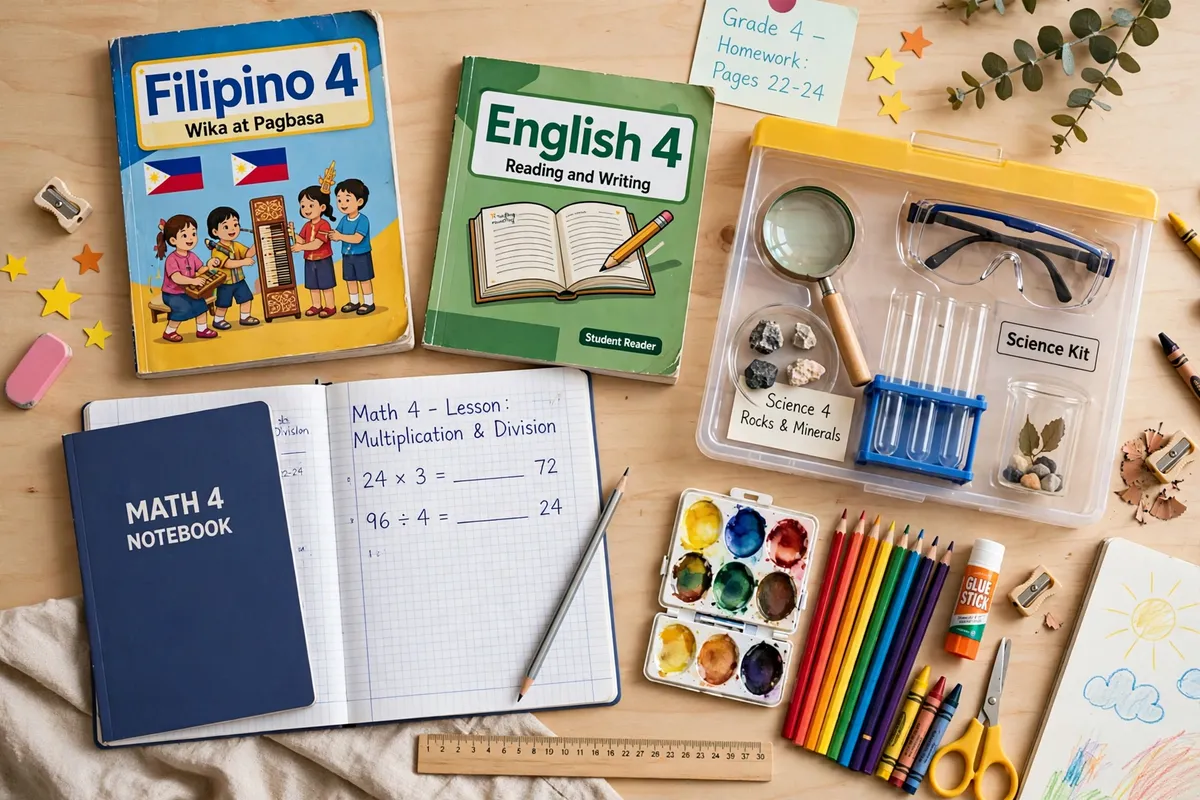
Under the MATATAG Curriculum, which reached Grade 4 in school year 2024–2025 as part of Phase 1, a Grade 4 learner takes these eight learning areas:
| # | Subject | Minutes per Day | Days per Week | Minutes per Week |
|---|---|---|---|---|
| 1 | Filipino | 45 | 5 | 225 |
| 2 | English | 45 | 5 | 225 |
| 3 | Mathematics | 45 | 5 | 225 |
| 4 | Science | 45 | 5 | 225 |
| 5 | Araling Panlipunan | 45 | 5 | 225 |
| 6 | MAPEH | 45 | 5 | 225 |
| 7 | EPP | 45 | 5 | 225 |
| 8 | GMRC | 45 | 5 | 225 |
On top of the eight subjects, the week also includes the National Mathematics Program (NMP), 30 minutes four times a week, and the Homeroom Guidance Program (HGP), 45 minutes once a week. Total: 390 minutes Monday to Thursday, 405 minutes on Friday. If you want the full K to 10 picture, our MATATAG time allotment guide lays out every grade level the same way.
Complete List of Grade 4 Subjects Explained
Grade 4 is the year the curriculum opens up. Here’s what each subject actually covers — and why teachers say Grade 4 is the biggest jump in elementary school.
1. Filipino
In Grade 4, Filipino moves from learning to read into reading to learn. Learners tackle longer texts, build richer vocabulary, and start writing paragraphs with real structure — not just sentences strung together. Grammar stops being a worksheet topic and becomes something they use when they write.
2. English
English runs alongside Filipino, and in Grade 4 the bar rises: reading grade-level texts with correct grammar, finding the main idea and supporting details, and writing clear sentences and short paragraphs. Teachers notice this is the year when learners start producing real compositions — short stories, letters, simple reports — instead of just answering questions.
3. Mathematics
Grade 4 Math leans hard into problem-solving: whole numbers and basic operations, patterns in numbers and shapes, measurement, and collecting and organizing data in tables and charts. Word problems get longer and more realistic. This is also where the National Mathematics Program (NMP) supports learners who need extra practice — 30 minutes, four days a week, on top of regular Math class.
4. Science
Science in Grade 4 is hands-on by design: properties of matter, living things and their systems, environmental changes, and simple investigations where learners observe, record, and explain. It’s the subject where “why does that happen?” finally gets a proper experiment instead of just an answer.
5. Araling Panlipunan
Araling Panlipunan is NEW in Grade 4 — it didn’t exist as a separate subject in Grade 3. Here it focuses on identity, community, and the relationship between people, society, and environment. Learners explore their community, local government, and the beginnings of Philippine geography and history. It’s the subject that turns “my barangay” into something they understand, not just live in.
6. MAPEH
MAPEH is also new in Grade 4, packing four components into one learning area: Music, Arts, Physical Education, and Health. Learners sing and play rhythms, draw and create, exercise and play sports, and learn basic health practices. Our MAPEH curriculum guide breaks down what each component covers from Grade 4 to Grade 10.
7. EPP
EPP — Edukasyong Pantahanan at Pangkabuhayan — is the third brand-new subject in Grade 4, and for many learners it’s the most exciting one. Practical life skills: ICT basics, agriculture, home management, and industrial arts. Learners plant, cook simple food, use a computer properly, and make things with their hands. EPP runs for Grades 4 to 6; in Grade 7 it becomes TLE.
8. GMRC
GMRC — Good Manners and Right Conduct — continues from the early grades as the values subject, now with deeper lessons: respect, honesty, responsibility, resolving conflicts peacefully, and empathy for others. It’s the subject that shapes how learners treat classmates, family, and community. In Grade 7, GMRC becomes Values Education. Our GMRC vs Values Education guide explains that transition side by side.
That full lineup is the complete answer to how many subjects in Grade 4 Philippines has — eight learning areas, no more, no less.
From Grade 3 to Grade 4: What Changes?
This is the part parents find most surprising, so let’s lay it out plainly. Grade 3 has six learning areas. Grade 4 has eight. Here’s the jump:
| Grade 3 (6 areas) | Grade 4 (8 areas) | |
|---|---|---|
| Language subjects | Filipino, English | Filipino, English (deeper, longer texts) |
| Math and Science | Mathematics, Science | Mathematics, Science (more inquiry, data, investigations) |
| Values | GMRC | GMRC (deeper values lessons) |
| Integrated subject | Makabansa | Makabansa folds into AP and MAPEH |
| NEW in Grade 4 | — | Araling Panlipunan, MAPEH, EPP |
The practical effect: a Grade 4 day is fuller, and homework spreads across more subjects. That’s normal — and it’s why Grade 4 is the year teachers say learners need to start managing their own bags, assignments, and study time. The subjects didn’t get harder overnight; there are just more of them, each with its own teacher’s expectations. Parents searching for how many subjects in Grade 4 Philippines has usually ask this right after the Grade 3-to-4 transition — and now you know exactly why the number jumps.
Grade 4 Weekly Time Allotment
Here’s the full weekly picture from DepEd’s time allotment for Grades 4 to 6. Every subject gets the same weight — 45 minutes a day, five days a week:
| Learning Area / Program | Minutes per Day | Days per Week | Minutes per Week |
|---|---|---|---|
| Filipino | 45 | 5 | 225 |
| English | 45 | 5 | 225 |
| Mathematics | 45 | 5 | 225 |
| Science | 45 | 5 | 225 |
| Araling Panlipunan | 45 | 5 | 225 |
| MAPEH | 45 | 5 | 225 |
| EPP | 45 | 5 | 225 |
| GMRC | 45 | 5 | 225 |
| NMP (program) | 30 | 4 | 120 |
| HGP (program) | 45 | 1 | 45 |
| Total per day | 390 minutes (Mon–Thu) / 405 minutes (Friday) | ||
Same flexibility note as other grades: DepEd Order No. 012, s. 2024 lets schools use Option B (50, 55, or 60-minute classes, some subjects four times a week) or propose their own Option C, as long as the school day stays at least 5 hours and 30 minutes and minimums hold — English, Math, Science, and GMRC never below 225 minutes a week; EPP, MAPEH, AP, and Filipino never below 200. Teachers building weekly plans can use our MATATAG lesson plan guide to match each subject to its competencies.
A Sample Grade 4 Class Schedule
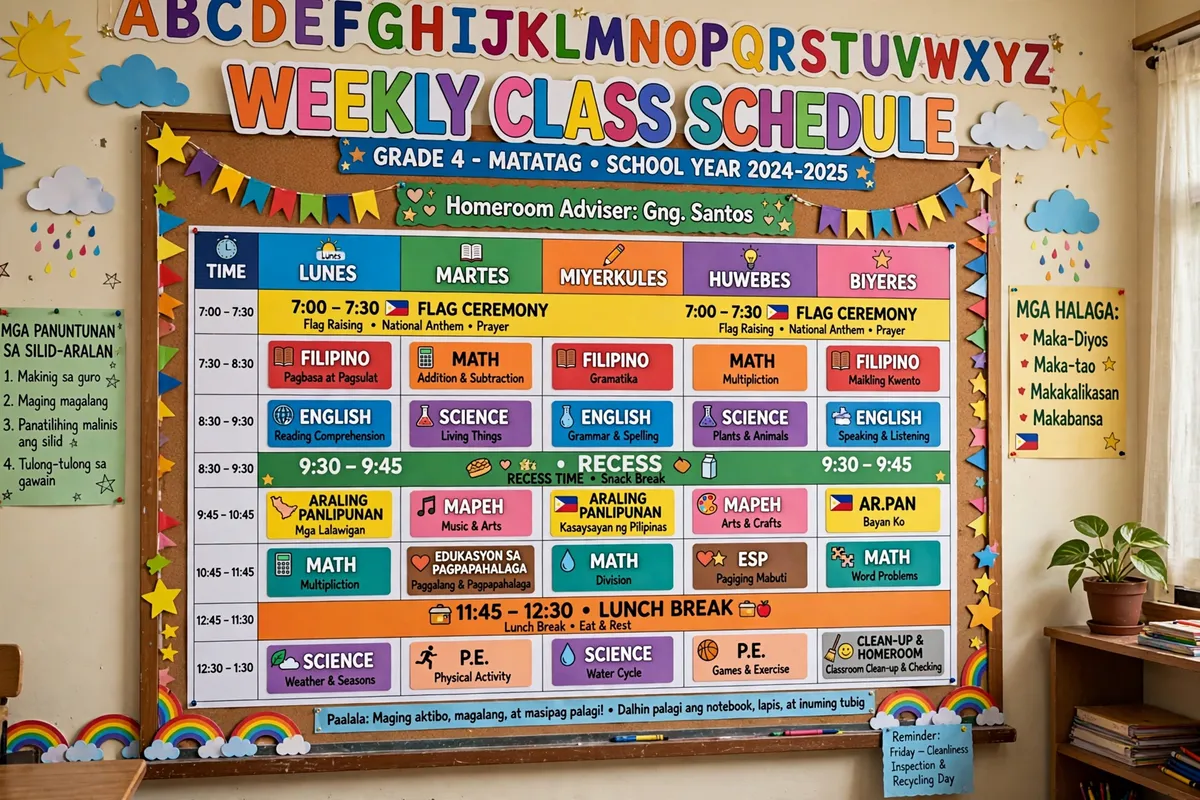
Here’s what a typical Grade 4 day looks like under Option A — taken from the standard MATATAG class program. Schools shuffle the order, but the minutes stay the same: Parents who ask how many subjects in Grade 4 Philippines has often want this schedule too, because it shows where each of the eight subjects actually sits in the day.
| Time | Minutes | Activity |
|---|---|---|
| 7:00 – 7:20 | 20 | Flag ceremony / Daily routine |
| 7:20 – 8:05 | 45 | GMRC |
| 8:05 – 8:50 | 45 | Filipino |
| 8:50 – 9:35 | 45 | Mathematics |
| 9:35 – 9:55 | 20 | Health break |
| 9:55 – 10:40 | 45 | English |
| 10:40 – 11:25 | 45 | Araling Panlipunan |
| 1:00 – 1:45 | 45 | MAPEH |
| 1:45 – 2:30 | 45 | Science |
| 2:30 – 3:15 | 45 | EPP |
| 3:15 – 3:45 | 30 | NMP (Mon–Thu) / HGP (Friday) |
Want this as a printable? Download the free Grade 4 Subjects Checklist PDF at the end of this article — one page, all eight subjects, with the weekly minutes and a checkbox column for tracking.
Frequently Asked Questions
How many subjects are there in Grade 4 under MATATAG?
The answer to how many subjects in Grade 4 Philippines has is eight: Filipino, English, Mathematics, Science, Araling Panlipunan, MAPEH, EPP, and GMRC. Each one gets 45 minutes a day, five days a week.
What is new in Grade 4 compared to Grade 3?
Three subjects are new: Araling Panlipunan, MAPEH, and EPP. Makabansa (the integrated Grade 1–3 subject) folds into AP and MAPEH. Filipino and English also become fully separate subjects with deeper content.
When did Grade 4 start using the MATATAG Curriculum?
Grade 4 joined the MATATAG rollout in school year 2024–2025, as part of Phase 1 (Kindergarten, Grades 1, 4, and 7) — the very first group of grades to use the new curriculum.
How many minutes is a Grade 4 school day?
390 minutes (6 hours 30 minutes) Monday to Thursday, and 405 minutes (6 hours 45 minutes) on Friday, including the flag ceremony, breaks, NMP, and HGP.
What is EPP in Grade 4?
EPP (Edukasyong Pantahanan at Pangkabuhayan) is the practical-skills subject: ICT basics, agriculture, family and consumer science, and industrial arts. It runs for Grades 4 to 6, then becomes TLE in Grade 7.
How are Grade 4 grades computed?
Grades follow the MATATAG grading system with written works, performance tasks, and quarterly assessments. Our guide on computing MATATAG grades walks through the exact formula step by step.
Conclusion
So, how many subjects in Grade 4 Philippines? Eight — Filipino, English, Math, Science, Araling Panlipunan, MAPEH, EPP, and GMRC — each getting 45 minutes a day. The real story of Grade 4 isn’t just the number, though. It’s the jump: three brand-new subjects, a fuller day, and the first year of the MATATAG Curriculum itself.
If you’re a parent, use the list above to check what your child is learning and where they might need help — especially in the three new subjects, where everything is unfamiliar at first. If you’re a teacher, the calculator and the checklist PDF should save you a few minutes of planning time every week. And if you’re moving up from Grade 3, expect the adjustment to take a month or so — then the eight-subject rhythm feels normal. For the full K to 10 overview, start at the MATATAG Curriculum and pick the grade you need.
Sources and References
- DepEd Order No. 010, s. 2024 — Policy Guidelines on the Implementation of the MATATAG Curriculum (time allotment for Grades 4–6, Phase 1 implementation SY 2024–2025)
- DepEd Order No. 012, s. 2024 — Additional provisions on the flexible implementation of the MATATAG Curriculum (Options A, B, C; minimum weekly minutes)
- Republic Act No. 11476 — GMRC and Values Education Act (GMRC as a separate learning area for Grades 1–6)
- DepEd MATATAG Curriculum Guide for Grade 4 — learning areas and competencies (Key Stage 2, Grades 4–6)