Kindergarten Curriculum Guide: What Your Child Learns Through Play (2026)
If you searched for a kindergarten curriculum guide, you are looking for the beginning of everything: the year when a Filipino child first enters formal school, learns through play, and builds the foundations — reading, writing, counting, getting along with others — that every later grade depends on. Under the MATATAG Curriculum, Kindergarten is not a watered-down Grade 1. It is its own stage, with its own goals, its own daily rhythm, and its own way of measuring progress.
This guide explains what Kindergarten actually teaches (six developmental domains, not subjects), what a typical day looks like (blocks of time, not periods), how teachers assess children without grades, and what the first term’s themes usually cover. There is a school-readiness checker tool for parents and a free PDF at the end.
Download the free Kindergarten checklist (PDF)
What Is the Kindergarten Curriculum Guide Under MATATAG?
Kindergarten is the first year of basic education, made mandatory by Republic Act No. 10157, the Kindergarten Education Act. The law’s objective is plain: prepare children for formal education, and give them the basic foundations of learning — the 3Rs of Reading, Writing, and Arithmetic — in a way suited to their age. The state policy behind it is that education at this stage must be learner-oriented and responsive to children’s needs, capacities, and abilities.
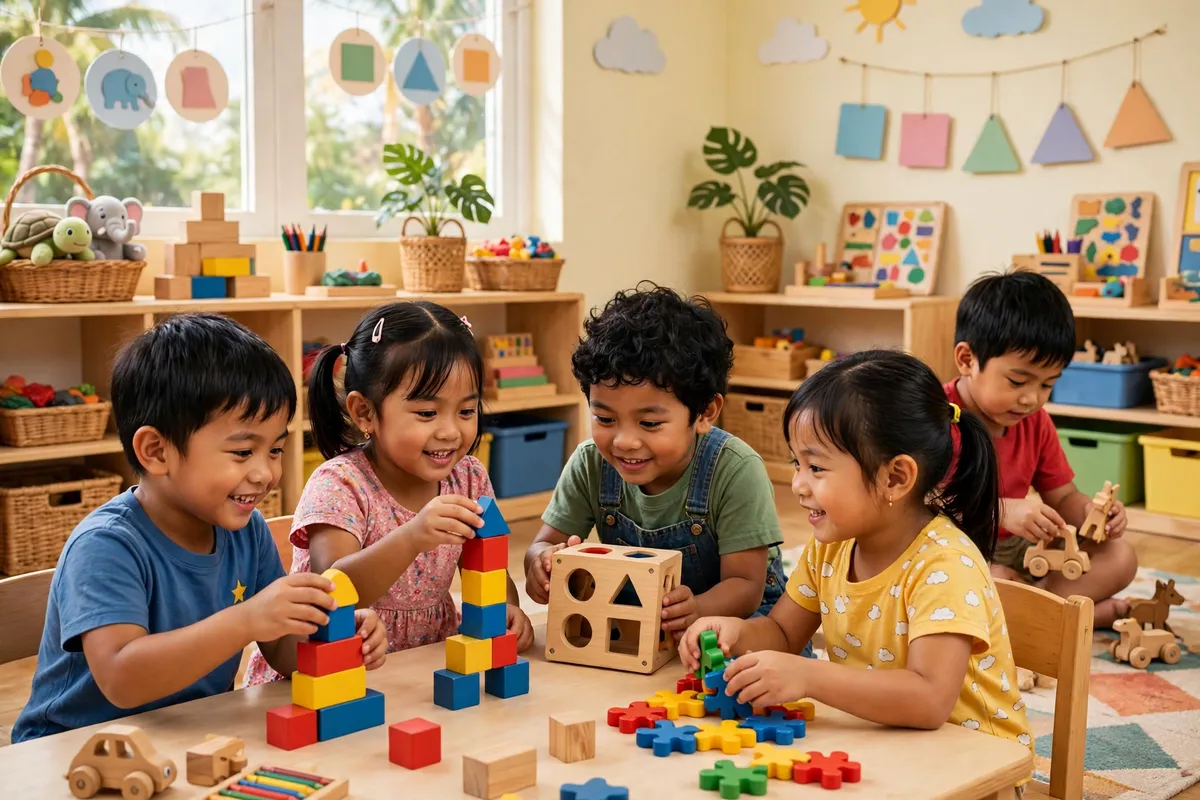
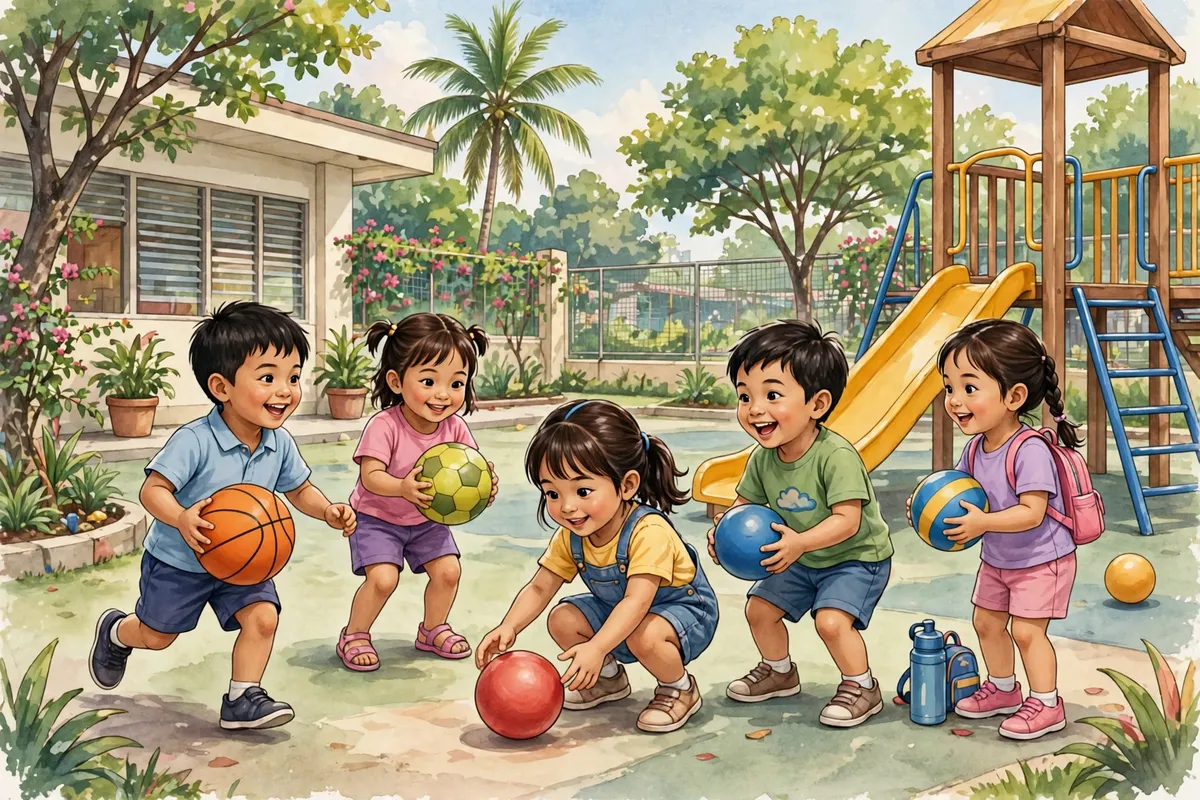
That last phrase is why Kindergarten looks so different from Grade 1. A five-year-old does not learn best sitting still for a 45-minute lecture. She learns by playing, moving, talking, singing, building, and pretending — and the MATATAG Kindergarten Curriculum is built around exactly that: a play-based, child-centered approach where learning happens through meaningful activities, not through seatwork. The curriculum’s goals name it directly: holistic development, 21st-century skills (critical thinking, communication, creativity, collaboration), and active engagement through hands-on activities.
Kindergarten joined MATATAG in the very first rollout phase, SY 2024-2025, alongside Grades 1, 4, and 7. So by SY 2026-2027, every Kindergarten classroom in the country is a MATATAG classroom.
The Six Developmental Domains (Not Subjects)
Here is the first surprise for parents used to subject lists: Kindergarten has no subjects. Instead, learning is organized into six developmental domains, and every activity touches several at once. A story-reading game, for example, builds language, cognitive skills, and socio-emotional learning at the same time. The domains also form the basis of the ECCD (Early Childhood Care and Development) Checklist used to track each child’s progress.
| Developmental Domain | What Children Develop |
|---|---|
| Language, Literacy, and Communication | Communicative skills in their first language, positive attitudes toward reading and writing, early literacy |
| Cognitive Development | Thinking and problem-solving, early numeracy, understanding living and non-living things, sorting and classifying |
| Socio-emotional Development | Self-awareness, managing feelings, getting along with others, appreciating diverse cultures |
| Values Development | Positive self-concept, respect for others, love for country and community |
| Physical Health and Motor Development | Fine and gross motor skills, health habits, safety awareness |
| Aesthetic / Creative Development | Creativity and self-expression through drawing, painting, music, movement, and imaginative play |
GMRC (Good Manners and Right Conduct) is woven into this picture too: under RA 11476, GMRC is integrated into kindergarten’s daily learning activities and play rather than taught as a separate subject — which starts only in Grade 1. And the Homeroom Guidance Program is naturally integrated into class activities, not given an additional meeting time. Values are caught in routines — lining up, sharing toys, saying thank you — not lectured.
A Typical Kindergarten Day: Blocks of Time
Kindergarten days run in blocks of time, not subject periods. The MATATAG Kindergarten Curriculum Guide suggests a 180-minute flow (plus arrival and free play at the start of the day). Here it is:
| Block of Time | Minutes | What Happens |
|---|---|---|
| Arrival Time / Free Play | — | Children arrive and play with educational toys and manipulatives |
| Meeting Time | 15 | Attendance, days of the week, checking the weather |
| Circle Time 1 | 45 | Story read-aloud or picture reading, valuing, and processing — the springboard for the day’s activities |
| Supervised Recess | 15 | Hands-on activities building table manners, independence, discipline, and healthy food habits |
| Quiet / Nap Time | 10 | Mindfulness and relaxing activities |
| Circle Time 2 | 40 | Engaging activities tied to the springboard: language, literacy, math, science, music and movement, arts and crafts |
| Indoor / Outdoor Play | 35 | Free and guided play, inside or outside |
| Wrap-Up Time | 20 | Reviewing the day, sharing, closing routines |
Notice the shape of the day: a story opens it, play carries it, and a calm wrap-up closes it. There is no hour of silent seatwork, because that is not how five-year-olds learn. If your child’s Kindergarten day looks like miniature Grade 1 — long written drills, heavy homework — that is worth asking the teacher about, kindly. The curriculum intends play to be the work.

Term 1 Themes: What Children Learn First
Kindergarten learning is organized into thematic units — teaching themes that weave the domains together. Term 1 typically follows a gentle sequence from self to world, which matches how young children understand life: first me, then my body, then my senses, then my feelings, then my family.
| Term 1 Weeks | Theme | What Children Explore |
|---|---|---|
| Weeks 1-2 | Knowing Me | My name, my school, who I am |
| Weeks 3-4 | My Body | Body parts and taking care of myself |
| Weeks 5-6 | My Senses | Using eyes, ears, nose, tongue, and skin |
| Weeks 7-8 | My Feelings | Recognizing and managing basic emotions |
| Weeks 9-10 | My Family | My home and the people I love, family roles, school personnel |
Teachers plan these themes through lesson exemplars built on an instructional design framework: Minds and Moods (activating prior knowledge through songs or games), Aims (the objective in child-friendly language), Tasks and Thoughts (the core play-based activity), Abstractions (generalizing — “why is it important to wash our hands?”), and Assessment (observation checklists or learner activity sheets). If you ever see a Kinder lesson plan, those five headings are why it reads differently from an older grade’s plan.
Kindergarten Readiness Checker (Tool)
Tick what your child can already do. This is an informal guide for parents — not a test and not a diagnosis. Every child develops at their own pace; a low count means “talk to the teacher about support,” never “your child is behind.”
How Teachers Assess Without Grades
Kindergarten children do not get numeric grades the way older learners do. Teachers assess through observation: watching children during play and activities, noting what they can do, and recording progress against the developmental domains on the ECCD Checklist. A teacher might note that a child now counts to 10 reliably, shares without prompting, or recognizes the first letter of her name — small, specific observations that add up to a real picture of growth.
For parents, this means the most useful question at a parent-teacher meeting is not “what grade did my child get?” but “what can my child do now that they couldn’t do last term, and what are we working on next?” That conversation — grounded in the domains, not a number — is exactly how Kindergarten assessment is designed to work.
Tips for Parents
- Read aloud every day. Even 10 minutes of story time builds vocabulary, listening, and love of reading — the foundation Grade 1 will build on.
- Let play be learning. Sorting laundry by color, counting plates, singing, building with blocks — all of it is Kindergarten curriculum in disguise.
- Practice routines, not drills. Packing a bag, following two-step instructions, waiting for a turn — these routines matter more than early worksheets.
- Talk, don’t quiz. Ask “what did you play today?” instead of “what did you learn?” — you’ll hear far more, and so will the teacher.
- Trust the pace. Children develop unevenly by design. A child who reads early but can’t share, and a child who shares beautifully but can’t count yet, are both normal.
Frequently Asked Questions
Is Kindergarten mandatory in the Philippines?
Yes. Republic Act No. 10157 (Kindergarten Education Act) made Kindergarten mandatory as preparation for Grade 1.
What does Kindergarten teach?
Not subjects, but six developmental domains: Language, Literacy and Communication; Cognitive; Socio-emotional; Values; Physical Health and Motor; and Aesthetic/Creative development — all through play-based activities.
How long is a Kindergarten day?
The suggested blocks of time total 180 minutes (Meeting Time, Circle Times, recess, quiet time, play, and wrap-up), plus arrival and free play.
Does Kindergarten have grades?
No numeric grades. Teachers assess through observation against the developmental domains, recorded on the ECCD Checklist.
What comes after Kindergarten?
Grade 1, with five learning areas: Language, Reading and Literacy, Mathematics, Makabansa, and GMRC — the first grade where subjects and a separate GMRC subject appear.
Is GMRC taught in Kindergarten?
Not as a separate subject. GMRC is integrated into kindergarten’s daily activities and play; it becomes a separate subject in Grade 1.
Conclusion
Kindergarten under MATATAG is a year of serious play: six developmental domains, a 180-minute day built around stories and play, themes that move from “me” to “my family,” and assessment by observation instead of grades. It prepares children for Grade 1 not by rushing them into it, but by building the language, thinking, social, physical, and creative foundations that make Grade 1 work.
If you want the blocks-of-time table, the domains, and a readiness checklist in one printable page, grab the free PDF below. For the complete subject picture across all grades, start at the MATATAG Curriculums homepage and follow the guides from there — including our MATATAG curriculum guide page and our MATATAG lesson plan guide for teachers planning Kinder lessons.
Sources & References
- Republic Act No. 10157 — Kindergarten Education Act
- DepEd MATATAG Curriculum Guide for Kindergarten (blocks of time, developmental domains, ECCD Checklist)
- Republic Act No. 11476 — GMRC and Values Education Act (GMRC integrated in kindergarten)
- DepEd Order No. 010, s. 2024 — Policy Guidelines on the Implementation of the MATATAG Curriculum