How Many Subjects in Grade 1 in the Philippines? (MATATAG Curriculum Complete List)
At the Grade 1 enrollment desk, a mother looked at her son’s class list and counted twice. “Language… Reading and Literacy… Ma’am, hindi po ba pareho lang yan?” The teacher smiled — she hears that question every year. “Magkaiba po sila, pero magkasama silang nagtuturo sa bata kung paano magbasa.”
If you’re enrolling a first-grader — or wondering why your child’s schedule looks different from what you remember — here’s the straight answer to the question every parent asks: how many subjects in Grade 1 Philippines has under the MATATAG Curriculum? Five. Just five learning areas, plus reading and math support programs. This guide lists all five, explains the Language vs Reading and Literacy confusion once and for all, shows the daily minutes, and gives you a free checklist and a small day planner for Grade 1.
Free Download: Grade 1 Subjects Checklist (PDF)
One page, all five subjects, daily minutes, the Language vs Reading explainer, and checkboxes for tracking.
Download the Grade 1 Subjects Checklist (PDF)
Grade 1 Day Planner (Tool)
Use this quick planner to see how a Grade 1 week adds up. Pick the class length your school uses, and it computes the weekly minutes for every subject and program.
The Short Answer: Grade 1 Has 5 Subjects
Under the MATATAG Curriculum, which reached Grade 1 in school year 2024–2025 as part of Phase 1, a Grade 1 learner takes these five learning areas:
| # | Subject | Minutes per Day | Days per Week | Minutes per Week |
|---|---|---|---|---|
| 1 | Language | 40 | 5 | 200 |
| 2 | Reading and Literacy | 40 | 5 | 200 |
| 3 | Mathematics | 40 | 5 | 200 |
| 4 | Makabansa | 40 | 5 | 200 |
| 5 | GMRC | 40 | 5 | 200 |
On top of the five subjects, the week also includes the National Reading Program (NRP), 30 minutes four times a week, the National Mathematics Program (NMP), 30 minutes four times a week, and the Homeroom Guidance Program (HGP), 40 minutes once a week (Friday). Total school day: 260 minutes Monday to Thursday, 240 minutes on Friday. If you want the full K to 10 picture, our MATATAG time allotment guide lays out every grade level the same way.
Complete List of Grade 1 Subjects Explained
Five subjects sounds small — until you realize two of them are both about reading, and one of them is brand new. Here’s what each one actually does.
1. Language
Language builds oral fluency: listening, speaking, and understanding the language the child actually speaks. DepEd gives Grade 1 teachers flexibility here — the language used is the one the learners know. Children tell stories, describe pictures, follow spoken instructions, and learn to express ideas out loud before they ever write them down. Talking well comes first; reading builds on talking.
2. Reading and Literacy
Reading and Literacy is where children learn to actually read: letters and sounds (phonics), sight words, reading short texts, and writing simple sentences. This is the “beginning reading” stage — sounding out words, building vocabulary, and moving from “I know the letters” to “I can read this page.” It’s the single most important subject in Grade 1, because every other subject after it assumes reading works.
3. Mathematics
Grade 1 Math is counting, number sense, simple addition and subtraction, shapes, and patterns — all taught with real objects first (blocks, beads, fingers) before written numbers. The NMP supports this with extra practice: 30 minutes, four days a week, for learners who need it.
4. Makabansa
Makabansa is the integrated subject that builds identity and community: family, school, barangay, national symbols, and Filipino culture. It’s taught through stories, songs, and activities rather than lectures. Makabansa runs for Grades 1 to 3, then folds into Araling Panlipunan and MAPEH from Grade 4. Our Makabansa curriculum guide explains it in detail for Grades 1 to 3.
5. GMRC
GMRC — Good Manners and Right Conduct — is the values subject: respect, honesty, kindness, following rules, and caring for others. In Grade 1 it’s taught through stories and everyday situations: saying please and thank you, waiting for your turn, telling the truth. In Grade 7, GMRC becomes Values Education. Our GMRC vs Values Education guide explains that transition side by side.
Language vs Reading and Literacy: What’s the Difference?
This is the question every Grade 1 parent asks, so let’s settle it clearly:
| Language | Reading and Literacy | |
|---|---|---|
| Main skill | Speaking and listening | Reading and writing |
| What children do | Tell stories, describe pictures, follow instructions, talk about ideas | Learn letters and sounds, read short texts, write sentences |
| Language used | The language the learners speak (teacher has flexibility) | Filipino and English foundations, built on oral language |
| Why both exist | Children must speak well before they read well | Reading turns spoken language into print |
Think of it this way: Language is learning to use words out loud. Reading and Literacy is learning to use words on paper. A child who can tell a clear story out loud will learn to read faster than a child who can’t — that’s why DepEd split them instead of mashing them into one subject. Parents searching for how many subjects in Grade 1 Philippines has usually trip over this pair first, because no other grade has two language subjects with such similar names.
Grade 1 Weekly Time Allotment
Here’s the full weekly picture from the MATATAG class program for Grade 1 (Annex A of DepEd Order No. 010, s. 2024). Each subject gets 40 minutes a day, five days a week:
| Learning Area / Program | Minutes per Day | Days per Week | Minutes per Week |
|---|---|---|---|
| Language | 40 | 5 | 200 |
| Reading and Literacy | 40 | 5 | 200 |
| Mathematics | 40 | 5 | 200 |
| Makabansa | 40 | 5 | 200 |
| GMRC | 40 | 5 | 200 |
| NRP (program) | 30 | 4 | 120 |
| NMP (program) | 30 | 4 | 120 |
| HGP (program, Friday) | 40 | 1 | 40 |
| Total per day | 260 minutes (Mon–Thu) / 240 minutes (Friday) | ||
One note: some schools use 45-minute classes instead of 40, under the flexibility DepEd Order No. 012, s. 2024 allows. The subjects stay the same five; only the minutes shift. Teachers building Grade 1 plans can use our MATATAG lesson plan guide to match each subject to its competencies.
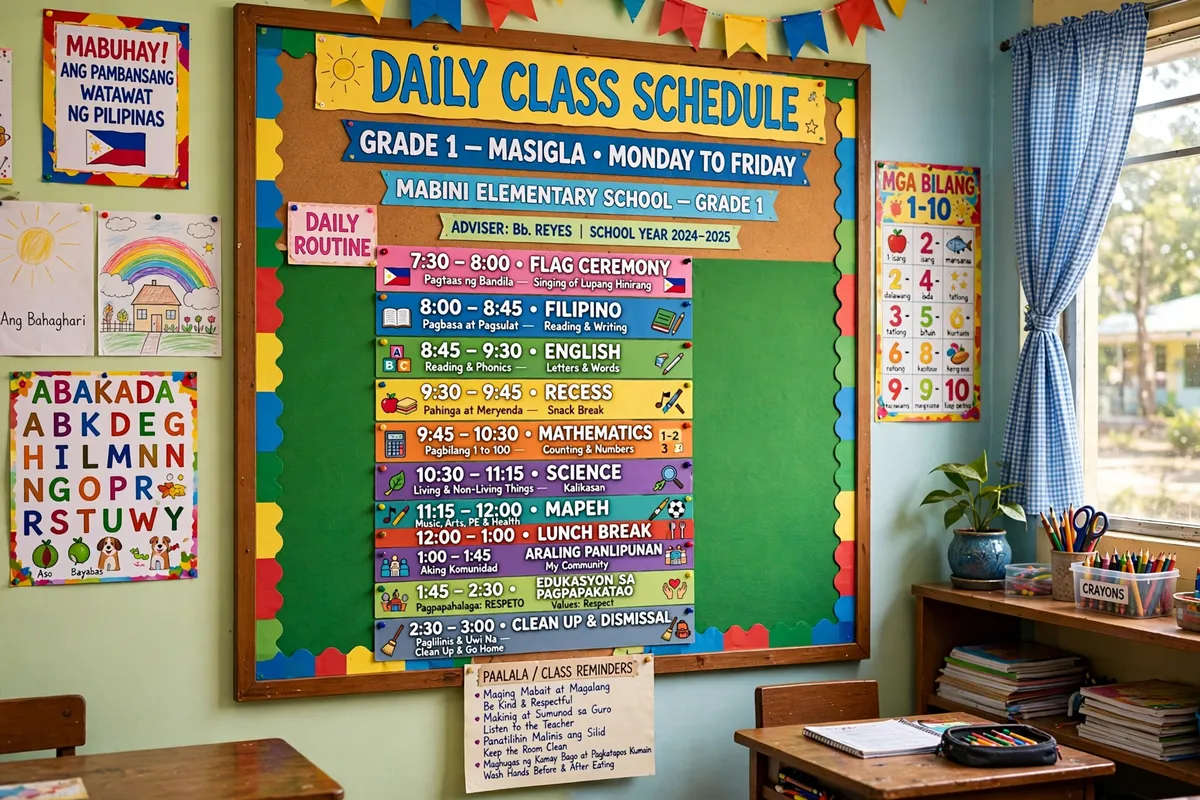
A Sample Grade 1 School Day
Here’s a typical Grade 1 day from the MATATAG class program. Schools adjust the order, but the blocks stay the same:
| Time | Minutes | Activity |
|---|---|---|
| 7:40 – 8:00 | 20 | Flag ceremony / Daily routine |
| 8:00 – 8:40 | 40 | Language |
| 8:40 – 9:20 | 40 | Reading and Literacy |
| 9:20 – 9:40 | 20 | Health break |
| 9:40 – 10:20 | 40 | Mathematics |
| 10:20 – 11:00 | 40 | Makabansa |
| 11:00 – 11:40 | 40 | GMRC |
| 11:40 – 1:00 | 80 | Health break / Noon break |
| 1:00 – 1:40 | 40 | Remediation |
| 1:40 – 2:10 | 30 | NRP (Mon–Thu) / HGP (Friday) |
| 2:10 – 2:40 | 30 | NMP |
Notice how short the day is compared to upper grades — and how much of it is reading and language. That’s the whole point of Grade 1: the day is built around learning to read. Want this as a printable? Download the free Grade 1 Subjects Checklist PDF at the end of this article.
From Kindergarten to Grade 1: What Changes?
For children, the biggest change isn’t the subjects — it’s the structure. Kindergarten is play-based: no formal subjects, six developmental domains, learning through stories, blocks, and movement. Grade 1 keeps the warmth but adds a real schedule: five subjects, fixed times, and the first real homework (usually just reading practice).
| Kindergarten | Grade 1 | |
|---|---|---|
| Approach | Play-based, integrated domains | Five formal learning areas |
| Reading | Emergent literacy (stories, letters, sounds) | Beginning reading (phonics, short texts) |
| Day length | About 180 minutes | 260 minutes (Mon–Thu) |
| New routines | Circle time, play centers | Fixed subject periods, NRP/NMP blocks |
The adjustment usually takes a few weeks. Children who went to Kindergarten adjust faster, because the routines (lining up, listening to the teacher, taking turns) are already familiar. If your child didn’t attend Kindergarten, the first month is about routines more than academics — and that’s completely normal. That transition is also why the answer to how many subjects in Grade 1 Philippines has is deliberately small: five subjects, so the new structure doesn’t overwhelm the new reader.
Frequently Asked Questions
How many subjects are there in Grade 1 under MATATAG?
The answer to how many subjects in Grade 1 Philippines has is five: Language, Reading and Literacy, Mathematics, Makabansa, and GMRC — plus NRP, NMP, and HGP support programs.
What is the difference between Language and Reading and Literacy?
Language builds speaking and listening (oral fluency); Reading and Literacy builds reading and writing (phonics, short texts, sentences). One teaches children to use words out loud, the other teaches them to use words on paper.
Is Mother Tongue still a subject in Grade 1?
No. Under MATATAG, Mother Tongue is no longer a separate subject. It is used as a medium of instruction, and Grade 1 teachers have flexibility to use the language the learners speak.
When did Grade 1 start using the MATATAG Curriculum?
Grade 1 joined the MATATAG rollout in school year 2024–2025, as part of Phase 1 (Kindergarten, Grades 1, 4, and 7).
How long is a Grade 1 school day?
260 minutes (4 hours 20 minutes) Monday to Thursday, and 240 minutes (4 hours) on Friday, including breaks, remediation, NRP/NMP, and HGP.
How are Grade 1 grades computed?
Grades follow the MATATAG grading system with written works, performance tasks, and quarterly assessments. Our guide on computing MATATAG grades walks through the exact formula step by step.
Conclusion
So, how many subjects in Grade 1 Philippines? Five — Language, Reading and Literacy, Mathematics, Makabansa, and GMRC — each getting 40 minutes a day, plus reading and math support that adds up to 280 extra minutes a week. It’s a small list on purpose: Grade 1 is the year children learn to read, and everything else in school depends on that one skill.
If you’re a parent, the best thing you can do is read with your child every day — even ten minutes — and let the school handle the rest. If you’re a teacher, the planner and the checklist PDF should save you a few minutes of planning time. And if your child just finished Kindergarten, expect a few weeks of adjustment to the new schedule — then the five-subject rhythm feels normal. For the full K to 10 overview, start at the MATATAG Curriculum homepage and pick the grade you need.
Sources and References
- DepEd Order No. 010, s. 2024 — Policy Guidelines on the Implementation of the MATATAG Curriculum (Grade 1 class program, Annex A; Phase 1 implementation SY 2024–2025)
- DepEd Order No. 012, s. 2024 — Additional provisions on the flexible implementation of the MATATAG Curriculum (45-minute class option)
- MATATAG Curriculum guides for Key Stage 1 — Grade 1 learning areas, beginning reading stage
- Republic Act No. 11476 — GMRC and Values Education Act (GMRC as a separate learning area for Grades 1–6)