GMRC vs Values Education in the MATATAG Curriculum: What’s the Difference? (2026)
If you’ve looked at your child’s class program lately and noticed “GMRC” in Grade 3 but “Values Education” in Grade 8, you’ve stumbled into one of the most confusing splits in the MATATAG curriculum. GMRC vs Values Education — are they the same subject with two names, or two genuinely different things? The answer is: they’re two different subjects, from the same law, doing different jobs for different ages. And once the logic clicks, it actually makes sense.
Here’s the honest version. GMRC (Good Manners and Right Conduct) and Values Education are the Philippine government’s answer to a question the country has argued about for thirty years: who teaches kids right from wrong, and when does it start? The subject vanished, came back, got a law named after it, and now sits on the class program five days a week. This guide breaks it all down — what each subject covers, which grades take what, how much time they get, and why lawmakers insisted on splitting them instead of keeping one.
The Short Answer: Two Subjects, One Mission
GMRC is taught in Grades 1 to 6 (and woven into Kindergarten’s daily activities). Values Education is taught in Grades 7 to 10, with GMRC concepts integrated into it. Both are core subjects, both come from one law — Republic Act No. 11476, the GMRC and Values Education Act of 2020 — and both replaced the old Edukasyon sa Pagpapakatao (ESP) in the K to 12 lineup.
The difference in one sentence: GMRC trains observable behavior; Values Education builds internalized values. GMRC is about doing the right thing — saying po and opo, lining up, telling the truth when you break a classmate’s pencil. Values Education is about understanding the why and choosing it for yourself — debating what honesty means in a cheating scandal, or why a teenager should care about a polluted river.
Think of GMRC as the roots and Values Education as the trunk. One doesn’t exist without the other, but you can see why a gardener treats them differently.
GMRC vs Values Education: Side-by-Side Comparison
The fastest way to see the difference is head to head:
| GMRC | Values Education | |
|---|---|---|
| Grades | 1 to 6 (integrated into Kindergarten daily activities) | 7 to 10 (GMRC concepts integrated into the subject) |
| Legal basis | RA 11476 — core subject, Grades 1–6 | RA 11476 — core subject, Grades 7–10 |
| Replaces | ESP in Grades 1–6 | ESP in Grades 7–10 |
| Core focus | Observable good behavior: manners, etiquette, respect, discipline | Internalized values: ethical principles, moral reasoning, civic virtues |
| How kids learn it | Habit-building, modeling, routines, stories | Discussion, reflection, case analysis, community action |
| Medium of instruction | Filipino | Filipino |
| Time allotment | 40–45 minutes/day, 5 days a week | 45 minutes/day, 5 days a week |
| Typical content | Paggalang, katapatan, kasipagan, disiplina, pagmamahal sa bayan | Nationalism, gender equity, ecology, peace and justice, academic integrity |
The Comeback Kid: How GMRC Disappeared, Then Returned
GMRC isn’t new. It’s a returnee.
Back in 1991, the Department of Education issued DepEd Order No. 90, s. 1991, which put Good Manners and Right Conduct on the elementary class program starting school year 1991–1992. It got 30 minutes a day, Grades I to VI, taught in Filipino. For a generation of Filipino kids in the nineties, GMRC was simply part of the school day — the subject where you learned why you stand when an elder enters the room.
Then 2013 happened. The K to 12 reform (RA 10533) overhauled the curriculum, and GMRC didn’t survive the redesign. Values formation got folded into Edukasyon sa Pagpapakatao (ESP) and scattered across subjects like Araling Panlipunan. The dedicated time and the name were gone.
Seven years later, Congress decided that wasn’t working. Republic Act No. 11476 — the GMRC and Values Education Act — was ratified in early 2020 and signed into law that June. It made GMRC a core subject from Grades 1 to 6, Values Education a core subject from Grades 7 to 10, and put GMRC into the daily learning activities of Kindergarten. The idea, in the lawmakers’ own framing, was to give values a name on the class program that no reform could quietly dissolve again.
The MATATAG curriculum then picked up the baton. Under DepEd Order No. 10, s. 2024, both subjects got full curriculum guides and real daily time slots in the decongested K–10 program. (Our breakdown of DepEd Order 010 covers the wider framework.) With the phased rollout now reaching Grades 6, 9, and 10 in school year 2026–2027, both subjects are finally running across the full K–10 span.
What GMRC Actually Teaches (Grades 1–6)
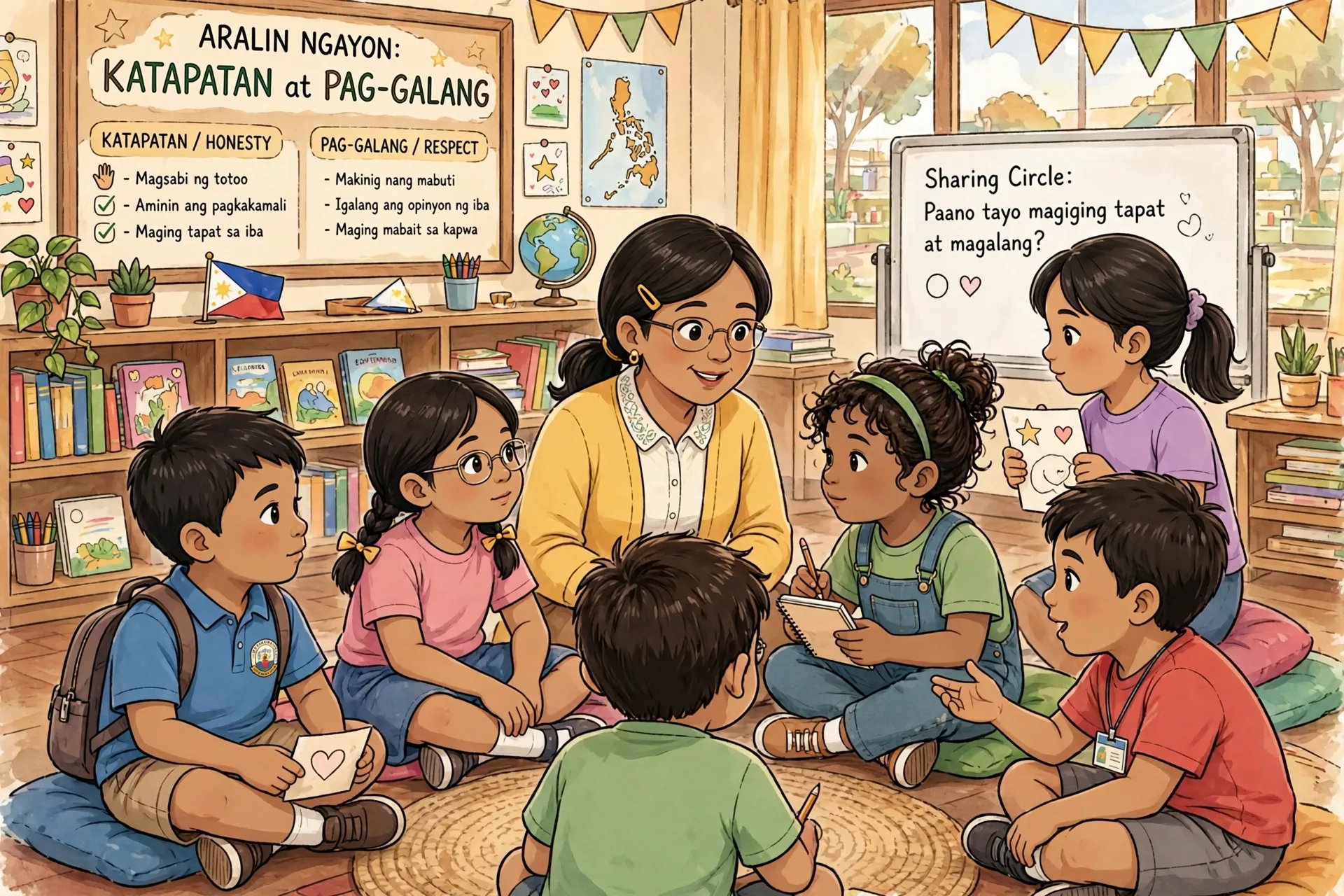
Walk into a Grade 2 GMRC class and you won’t find abstract philosophy. You’ll find a teacher reminding kids to greet with “mano po,” a chart of classroom rules, a story about a child who returned a lost coin. GMRC works on what children can be seen doing — the conduct, not the theory.
The law sketches the subject’s basic tenets: caring for oneself, giving concern for others, proper respect, discipline and order, sincerity, honesty, obedience — and above all, love of country. In classroom language, that becomes the vocabulary every Filipino teacher knows: paggalang (respect), katapatan (honesty), kasipagan (industriousness), pagiging matulungin (helpfulness), pagmamahal sa bayan (love of country).
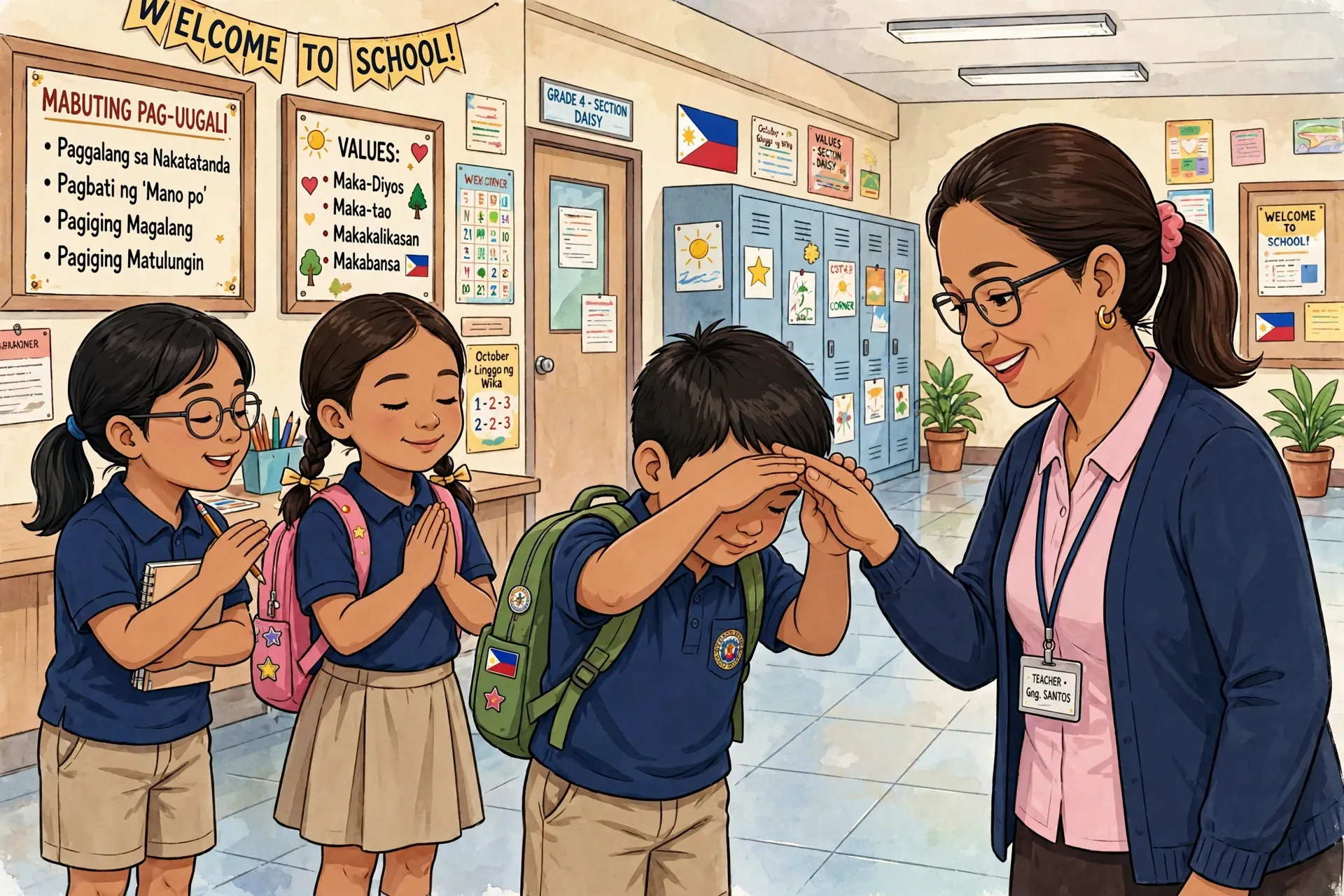
The method is habit-building, because that’s how seven-year-olds actually learn values. A Grade 1 teacher doesn’t lecture about respect — she insists on “po” and “opo” fifty times a day until it becomes reflex. A Grade 4 teacher doesn’t assign an essay on discipline — he makes lining up before the flag ceremony non-negotiable. The curriculum’s own stated goal points at exactly this: young Filipinos who decide responsibly, behave with proper conduct, and live with love for God, family, fellow citizens, nature, and country.
Typical GMRC ground covers, year by year, things like:
- Self-care and discipline — personal hygiene, keeping belongings in order, following school rules, finishing tasks on time
- Respect for others — the mano po greeting, speaking politely, listening when others talk, treating elders with courtesy
- Honesty — telling the truth even when it’s costly, returning lost things, owning up to mistakes
- Helpfulness and cooperation — sharing materials, helping a classmate who fell behind, group chores
- Love of country — singing the national anthem with feeling, caring for the classroom and school grounds, pride in being Filipino
Notice what’s missing: debate, abstraction, moral dilemmas with no clean answer. That’s deliberate. A Grade 3 pupil doesn’t need a lecture on moral philosophy — she needs fifty small repetitions of the right thing until her hands know it.
What Values Education Teaches (Grades 7–10)
Then the child turns twelve, and everything changes.
A thirteen-year-old can spot hypocrisy from across the room. Tell a Grade 8 class “be honest” and they’ll ask why the class treasurer’s accounting doesn’t add up. Values Education exists for exactly that stage — when kids stop accepting rules on authority and start demanding reasons. The subject takes the same values GMRC drilled as habits and asks the uncomfortable follow-up questions.
The law’s tenets for this level run wider and heavier: respect for oneself, others, and elders; intercultural diversity; gender equity; ecology and the care of creation; peace and justice; obedience to the law; nationalism and global citizenship; patience, perseverance, and industry; honesty and integrity; good faith in dealing with others. These aren’t bullet points on a poster anymore — they’re topics for discussion, case studies, and action.
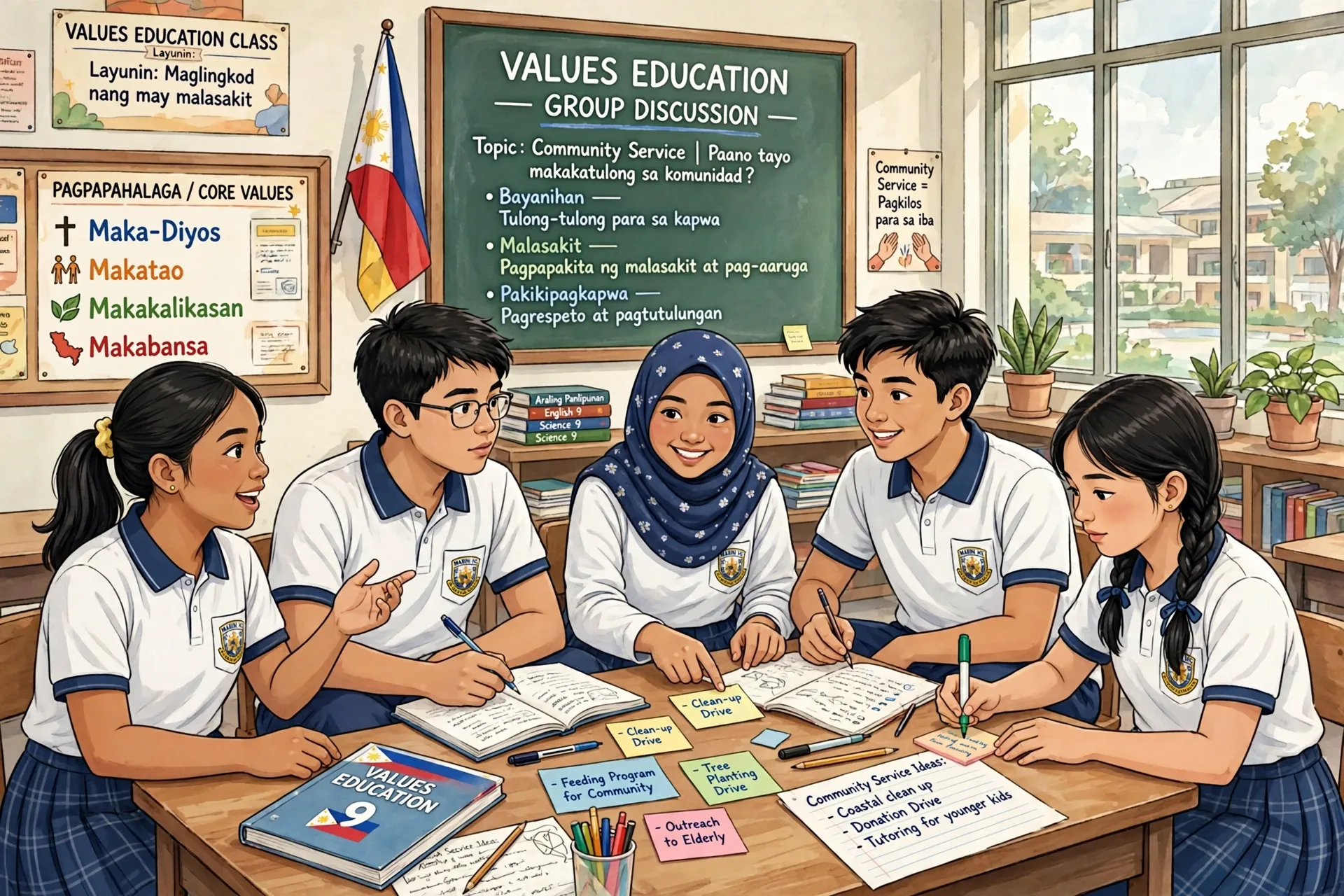
So what does that look like on a Wednesday? A Grade 9 lesson on ecology doesn’t end with “take care of nature” — it ends with a barangay cleanup, a reflection journal, and a class discussion on why the drainage still floods every June. A lesson on nationalism ties the Constitution’s preamble to students’ own lives. Honesty becomes a frank conversation about academic integrity: what counts as cheating, and what integrity costs when everyone else cuts corners.
The shift from GMRC to Values Education, in plain terms:
- Behavior → reasoning: from “do this” to “here’s why this is right”
- Rules → principles: from classroom rules to ethical frameworks a student can carry anywhere
- Personal → civic: from respect for the person beside you to respect for communities, the environment, and the country
- Imitation → choice: from copying the teacher to making a decision the teacher might never see
And the GMRC content doesn’t get discarded — the law says GMRC is integrated into Values Education at these levels. The habits from elementary school are the floor the deeper conversation stands on.
Time Allotment and Medium of Teaching
Both subjects get serious, protected time. DepEd Order No. 10, s. 2024 gives every learning area 45 minutes a day, five days a week — and GMRC and Values Education are on that list with no asterisks. When DepEd Order No. 012, s. 2024 later allowed schools to flex their schedules, it drew a hard line: English, Mathematics, Science, and GMRC/Values Education must be taught five times a week, with no less than 225 minutes per week for those subjects.
Here’s how it breaks down per level:
| Level | Subject | Time per week | Medium |
|---|---|---|---|
| Kindergarten | GMRC (integrated, not a separate subject) | Integrated into daily learning activities | Filipino / first language |
| Grades 1–2 | GMRC | 40 minutes/day, 5 days a week | Filipino |
| Grades 3–6 | GMRC | 45 minutes/day, 5 days a week | Filipino |
| Grades 7–10 | Values Education (GMRC integrated) | 45 minutes/day, 5 days a week (min. 225 min/week under DO 012) | Filipino |
A few notes worth knowing. First, both subjects are taught in Filipino — GMRC from the start, and Values Education in Key Stage 3, where DepEd’s medium-of-instruction table places it alongside Filipino and Araling Panlipunan. Second, the slightly shorter 40-minute slot in Grades 1–2 matches the early-grades schedule in our MATATAG time allotment guide — the littlest kids get the same daily frequency, just gentler sessions.
Third, the 225-minute floor matters. Under the flexible-schedule options, a school can rearrange a lot — but it cannot quietly shrink values formation to make room. GMRC and Values Education sit in the same protected group as English, Math, and Science. That tells you exactly how DepEd ranks this subject.
Why Split It Into Two Subjects at All?
Fair question. If it’s all “values,” why not one subject from Grade 1 to Grade 10?
The honest answer is developmental. A six-year-old and a fifteen-year-old are not the same kind of moral thinker. The six-year-old learns by imitation and repetition — she becomes respectful by practicing respect. The fifteen-year-old learns by reasoning and testing — he becomes principled by arguing about principles and watching them hold up (or fail) in real situations. One pedagogy can’t serve both: GMRC’s habit-building would bore a Grade 9 class, and Values Education’s case debates would baffle a Grade 2 class.
There’s also a political answer, worth saying plainly. The last time values education was folded into other subjects — the ESP era under K to 12 — it gradually lost its time, its teachers, and its visibility. A named subject on the class program is armor. When “GMRC” appears five times a week on a teacher’s load, it gets taught. When it’s a theme inside another subject, it gets whatever minutes are left over.
And it’s one continuous pipeline. GMRC’s habits are explicitly carried into Values Education in Grades 7–10. The kid who learned to line up in Grade 3 is the teenager debating civic duty in Grade 9 — the same formation, grown up.
What Happened to ESP? Where Do Makabansa and HGP Fit?
If you taught under K to 12, you’re wondering about Edukasyon sa Pagpapakatao. ESP is gone as a subject. RA 11476 replaced it: GMRC takes its place in Grades 1–6, Values Education in Grades 7–10. If your old lesson plans say “ESP,” the new class program says one of those two names.
| Old (K to 12) | MATATAG now |
|---|---|
| ESP, Grades 1–6 | GMRC, Grades 1–6 |
| ESP, Grades 7–10 | Values Education, Grades 7–10 |
| GMRC folded into other subjects | GMRC as its own subject (plus integrated in Kindergarten) |
Two neighbors are worth distinguishing so they don’t get confused with the main pair. Makabansa (Grades 1–3) touches related values — community, identity, care for the environment — but it’s a separate learning area with its own competencies; it didn’t absorb GMRC, and GMRC didn’t absorb it. And the Homeroom Guidance Program (HGP) runs 45 minutes once a week as a guidance session, not a graded subject. It complements values formation beautifully — counseling, career guidance, life skills — but it’s not where the curriculum’s values content lives. Different job, different slot.
Teaching GMRC and VE: What Actually Works
What separates a GMRC class kids remember from one they sleep through? Teachers who do this well converge on the same handful of practices.
- Model it, don’t just teach it. A teacher who says “po” to the janitor teaches more respect in ten seconds than a week of lectures. Kids copy conduct before they absorb concepts — especially in the GMRC years.
- Use real situations, not hypotheticals. The spilled paint, the lost wallet, the quarrel at recess — these are the curriculum arriving unannounced. Pause the lesson plan and work the moment. It sticks.
- Build short daily rituals. A five-minute honesty check-in at the end of the day, a weekly “bayani ng linggo” (hero of the week) recognition — small, repeated, and owned by the class.
- Move VE students from talk to action. Reflection journals, community service, barangay immersion, position papers on real local issues. A Grade 10 student who organized a coastal cleanup understands ecology in a way no quiz can test.
- Assess the conduct, not just the answers. Performance tasks, anecdotal records, and rubrics that capture participation and behavior — consistent with the MATATAG grading system where performance tasks carry real weight. (See our guide to computing grades under MATATAG.)
- Bring parents in. A values report that goes home — one line about what the child did well this week — turns the household into the second classroom. More on that next.
For Parents: Reinforcing Values at Home
Teachers will tell you quietly: five 45-minute sessions a week can’t compete with what happens at home the other 160 hours. GMRC and Values Education work when the household plays along — and that requires consistency, not a teaching degree.
- Keep the small rituals. The mano po greeting, saying grace before meals, thanking the tricycle driver — children treat home habits as the real rules and school habits as the performance. Make the home ones count.
- Give chores real dignity. Washing dishes, folding laundry, sweeping the yard — this is where kasipagan and discipline actually get built, not in a worksheet.
- Talk through dilemmas, don’t just rule on them. When your teenager asks why cheating is wrong “if everyone does it,” resist the lecture. Ask what kind of person does that make someone. Values Education homework is basically that conversation — join it.
- Praise specific conduct. “You’re a good kid” evaporates. “I saw you share your baon with your classmate without being asked — that’s real pagiging matulungin” gets remembered.
- Stay in touch with the teacher. Ask what values theme the class is working on this quarter and echo it at home. The Homeroom Guidance sessions are a natural touchpoint — use them.
Frequently Asked Questions
Is GMRC the same as ESP?
No. ESP (Edukasyon sa Pagpapakatao) was the old K to 12 values subject. Republic Act No. 11476 replaced it — GMRC now covers Grades 1–6 and Values Education covers Grades 7–10. If your child’s report card says GMRC or Values Education, that’s the current subject.
My child is in Kindergarten. Is there a GMRC class?
Not as a separate subject. Under RA 11476, GMRC is integrated into the daily learning activities of Kindergarten rather than taught as its own class. The standalone subject starts in Grade 1.
Are GMRC and Values Education graded subjects?
Yes. Both are core subjects with the same standing as English or Math — they carry grades on the report card and count toward promotion, assessed through written works, performance tasks, and quarterly assessments like other learning areas.
What language are they taught in?
Filipino. GMRC is taught in Filipino from Grade 1, and Values Education in Grades 7–10 is also taught in Filipino under the MATATAG medium-of-instruction rules.
Our school uses a flexible schedule. How many minutes must GMRC get?
Under DepEd Order No. 012, s. 2024, schools may rearrange schedules (Options A, B, or C), but GMRC/Values Education must still be taught five times a week with no less than 225 minutes per week — the same protected floor as English, Math, and Science.
Is Values Education the same as a religion class?
No. Values Education is a secular subject on civic and ethical values — honesty, justice, nationalism, environmental care. While the law’s goals include love of God among the values, the subject is not catechism or religious instruction; it’s open to all learners regardless of faith.
Conclusion
GMRC vs Values Education isn’t a rivalry — it’s a relay. GMRC gives young children the habits: the greeting, the honesty, the discipline, repeated until they’re reflex. Values Education gives teenagers the reasons: the principles, the debates, the choices made when nobody’s watching. One law, two subjects, ten grade levels of formation — and a protected place on the class program that no future reform can quietly erase.
If you’re a teacher, start with the habit and trust the reasoning to follow. If you’re a parent, the school is doing its 45 minutes — the other 160 hours are yours.
Sources & References
- Republic Act No. 11476 — GMRC and Values Education Act (via Academ-e Philippines, The New MATATAG GMRC and VE Curriculum)
- DepEd Order No. 10, s. 2024 — Policy Guidelines on the Implementation of the MATATAG Curriculum
- DepEd Order No. 012, s. 2024 — flexible class schedule guidelines (deped.gov.ph; also reported by Inquirer and SunStar)
- DepEd Order No. 90, s. 1991 — Good Manners and Right Conduct at the elementary level
- Manila Standard, March 2020 — GMRC ratified as part of basic education
- CFAM Philippines — Unpacking the MATATAG GMRC/VE Curriculum
- Related on this site: DepEd Order 010 s. 2024 Explained, MATATAG Time Allotment Per Subject, How to Compute Grades in the MATATAG Grading System, MATATAG vs K to 12