MATATAG Filipino Curriculum Guide: What Teachers Need to Know (2026)
Sir Domingo teaches Grade 2 in Davao. Last school year, his classroom ran on Bisaya — mother tongue was the rule, and he was good at it. This year, the memo on his desk says the medium of instruction for K to 3 is now Filipino and English. Same kids. Same 40 minutes a day. Completely different job description.
He’s not alone. Thousands of Filipino teachers are opening the MATATAG Filipino curriculum guide for the first time this school year and realizing the subject they thought they knew has been rebuilt underneath them — new key stages, new subdomains, and a brand-new law (RA 12027) that flipped the language policy on its head.
This MATATAG Filipino curriculum guide walks through what actually matters: where Filipino sits in the MATATAG timetable, what the mother-tongue change means for your classroom, how the three key stages work, what the subdomains really ask you to teach, and how to survive the 45-minute period. No policy-speak. Just the parts you need on Monday morning.
Where Filipino Actually Sits in MATATAG
First, the map — because this is where most confusion starts. Under the MATATAG Filipino curriculum guide, Filipino is not a standalone subject in Grade 1. Six- and seven-year-olds take Language and Reading and Literacy instead, two 40-minute blocks a day that build oral fluency and beginning reading in the child’s first language.
Filipino walks in as its own subject in Grade 2 and stays all the way through Grade 10. Here’s how it lays out:
| Grade | Filipino under MATATAG | Minutes per day |
|---|---|---|
| Grade 1 | No standalone Filipino — folded into Language and Reading and Literacy | — |
| Grade 2 | Filipino as a learning area | 40, five times a week |
| Grades 3–6 | Filipino as a learning area | 45, five times a week |
| Grades 7–10 | Filipino as a learning area | 45, five times a week |
One caveat: under the flexible Option B schedule (DepEd Order No. 12, s. 2024), Filipino drops to four sessions a week while English, Math, Science, and GMRC stay at five. Same minutes per period — one less day. That’s exactly why the decongested competencies matter: fewer things to teach means four days can still cover the quarter.
The Mother-Tongue Earthquake: What RA 12027 Changed for You
Here’s the short version of the biggest policy flip in a decade. Republic Act No. 12027 — which lapsed into law on October 10, 2024 — discontinued the mandatory use of the mother tongue as the medium of instruction from Kindergarten to Grade 3. The medium reverted to Filipino and English, in line with the 1987 Constitution. Then DepEd Order No. 20, s. 2025, signed by Secretary Sonny Angara, made it classroom-official: K–3 instruction “shall primarily be Filipino and English,” explicitly rescinding the Key Stage 1 language provisions of DepEd Order No. 10, s. 2024 — the very order that launched MATATAG.
What does this mean for you, practically? Three things. First, your K–3 classroom now runs on Filipino and English. If you’ve been teaching in Cebuano, Ilokano, or Hiligaynon, the default flipped. You’re not forbidden from using the learners’ first language — DepEd encourages translanguaging, the deliberate back-and-forth between languages — but lessons, materials, and assessments now default to Filipino and English.
Second, mother tongue isn’t dead — it’s optional, with a steep checklist. Monolingual classes may keep using it, but only with a KWF-published orthography, documented vocabulary, cultural literature, a grammar book, and enough trained teachers. Most schools won’t clear that bar. Know the rule so you can answer parents who ask.
Third, the Filipino subject didn’t change — its load got heavier. Filipino was always a learning area from Grade 2 up. What’s new is that it now carries more of the early-grades communication burden mother tongue used to shoulder. Your Grade 2 and 3 Filipino periods do double duty: teaching the subject and building the academic language kids need everywhere else. Consider this MATATAG Filipino curriculum guide your cheat sheet for that double duty — the policy summary above, the classroom strategies below. For the full backstory on the medium-of-instruction rules, see our medium of teaching and learning guide.
Three Stages, Three Different Jobs
The MATATAG Filipino curriculum guide organizes the subject into three key stages. Each stage has one clear job. If you remember nothing else, remember this table:
| Stage | Grades | The job | Text mix |
|---|---|---|---|
| Key Stage 1 | K–3 | Foundation — basic literacy and fluency in listening, speaking, reading, and writing | 70% narrative, 30% informational |
| Key Stage 2 | 4–6 | Application — using literacy for real purposes; applied and critical literacy | 50% narrative, 50% informational |
| Key Stage 3 | 7–10 | Mastery — analyzing and producing four distinct kinds of text | Literary, informational, academic, transactional |
Key Stage 1 is about getting the engine running. By the end of Grade 3, learners should handle familiar, age-appropriate texts — and handle them fluently: not just accurately, but quickly, smoothly, and with expression. That changes how you drill. A Grade 2 class chanting a tula in flat monotone is technically reading. It isn’t fluent. The guide wants the music in the language.
Key Stage 2 is where reading stops being the point and starts being the tool: following multi-step written directions, comparing two accounts of the same event, writing a letter that actually persuades someone. The 50/50 narrative-to-informational split is the tell — half of what your Grade 4–6 learners read should now be non-story text.
Key Stage 3 is the deep end. Four text families — literary, informational, academic, transactional — each with its own conventions to master. A Grade 7 learner analyzing a Philippine poem (literary), a Grade 9 learner writing a research-style report (academic), a Grade 10 learner drafting a formal request letter (transactional). This is senior-high-level work by the old standards, which is exactly the point of the decongestion: fewer competencies, taught harder.
The Subdomains: What You’re Really Teaching
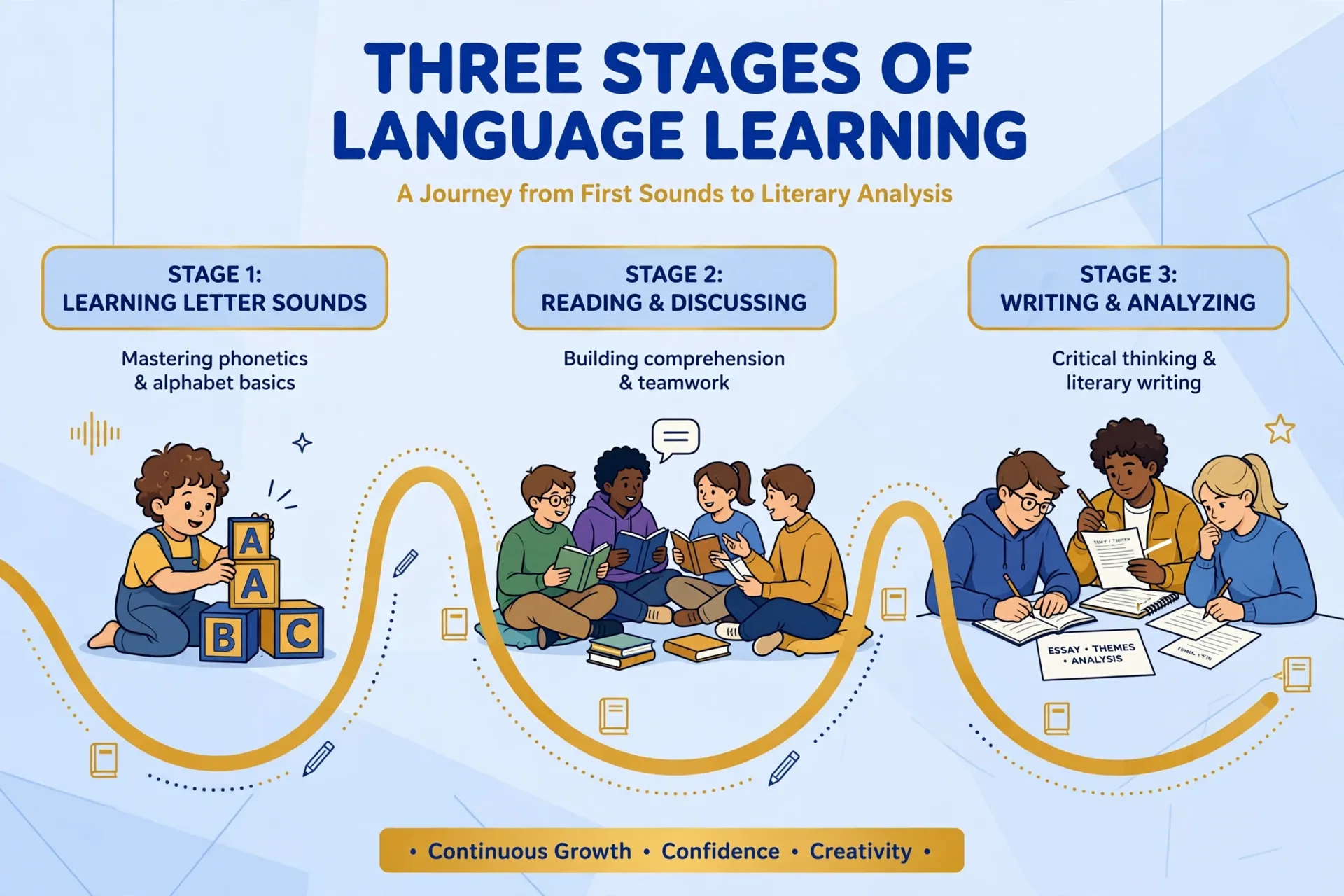
The MATATAG Filipino curriculum guide groups its competencies into subdomains — skill families. The old guides had a longer, messier list; MATATAG merged subdomains “of the same nature” to kill the congestion. Each stage, translated out of document-speak:
Key Stage 1 (Grades 1–3): the building blocks
Eleven subdomains, but they cluster into four instincts:
- Sound and word work: Phonological Awareness (hearing sounds inside words), Phonics and Word Study (matching sounds to letters), Vocabulary and Word Knowledge (what words mean). This is the decoding engine.
- Using language with people: Language for Interacting with Others (conversations, requests, politeness) and Creating Oral Texts (retelling, reciting, show-and-tell). If learners can talk, they can write later.
- Thinking with language: Grammar Awareness and Grammatical Structures (how sentences work), Language for Developing and Expressing Ideas, and Appreciating Languages — yes, noticing that languages are beautiful is a real subdomain.
- Working with texts: Interacting with Texts, Comprehending and Analyzing Texts, Creating and Composing Texts. Read it, get it, make your own.
Notice what’s not here: weekly lockstep. The old format pinned competencies to specific weeks. MATATAG instead assigns each competency a learning duration in quarters, and you bundle them into learning episodes. That flexibility is a gift — if you plan — and a trap if you don’t.
Key Stage 2 (Grades 4–6): the three workhorses
- Listening and Reading — taking language in. Stories, articles, speeches, media.
- Speaking and Writing — putting language out. Discussions, reports, compositions, speeches.
- Viewing and Representing — the visual channel. Reading images, charts, and videos; making posters, diagrams, and presentations.
Viewing and Representing is the one teachers underestimate. Your learners live on screens. A Grade 5 lesson that asks them to “read” an infographic about typhoon preparedness and then make a better one teaches two subdomains at once — and it’s the kind of lesson kids remember.
Key Stage 3 (Grades 7–10): the four text families
- Literary Texts — Philippine literature: poetry, short stories, drama, essays. Analysis of structure, style, and meaning; original creative writing that reflects local and national identity.
- Informational Texts — news, features, explanations. Reading for accuracy, bias, and purpose.
- Academic Texts — research-style writing. Citing, organizing, arguing with evidence.
- Transactional Texts — the practical stuff: letters, forms, memos, proposals. The texts adults actually write.
The panitikan strand lives inside Literary Texts, and it deserves more than a token poem in August for Buwan ng Wika. When a Grade 7 class analyzes a tula’s tayutay and then writes their own saknong about their barangay, that’s the subdomain working as designed: evaluate literature, then publish original texts rooted in identity.
Your Actual Week: Time Allotment
Here’s the timetable reality under the MATATAG Filipino curriculum guide. Filipino gets a daily slot — and in a 45-minute period, every minute has to earn its place:
| Grade level | Minutes per day | Sessions per week | Weekly total |
|---|---|---|---|
| Grade 2 | 40 | 5 | 200 minutes |
| Grades 3–6 | 45 | 5 | 225 minutes |
| Grades 7–10 | 45 | 5 | 225 minutes |
Two hundred twenty-five minutes a week sounds generous until you divide it by everything the subdomains demand. The teachers who make it work don’t teach five mini-lessons a day — they build the period around one strong text or task and let the subdomains ride along. A single maikling kuwento (short story) can carry vocabulary (pre-teach five words), comprehension (guided questions), grammar (pull two sentence patterns from the text), and composition (write an alternate ending). Four subdomains, one period, one preparation.
For the full per-subject breakdown across all grade levels, see our MATATAG time allotment guide — and if your school adopted the flexible Option B schedule, confirm whether your Filipino periods dropped to four a week before you finalize your quarterly plan.
Where Teachers Usually Trip Up
I’ve watched enough Filipino classes — and read enough teacher forums — to spot the recurring traps. Most aren’t about effort. They’re about old habits meeting a new guide.
- Teaching Filipino as “English, but translated.” The two subjects share a structure under MATATAG, but Filipino has its own soul: panitikan, tayutay, bugtong, salawikain. If your Filipino period could be swapped with English and nobody would notice, something’s off. Compare with our MATATAG English curriculum guide and keep each subject’s identity sharp.
- Skipping the oral work. Creating Oral Texts and Language for Interacting with Others are real subdomains, not warm-up activities. The recitation, the debate, the dula-dulaan — that’s the curriculum, not the appetizer.
- Treating panitikan as decoration. One poem in August for Buwan ng Wika, then grammar drills the rest of the year. Key Stage 3’s Literary Texts subdomain expects sustained work: analysis and original composition, every quarter.
- Drowning in the 45 minutes. Don’t try to hit every subdomain daily. Pick one anchor text per period, name the 2–3 subdomains it serves, and let the rest rotate through the week.
- Ignoring the viewing strand. Learners who can decode a paragraph but can’t read a chart critically are half-literate by MATATAG’s definition. Fold one visual text into your week.
What a Good Week Looks Like
Theory’s fine. Here’s a concrete Grade 5 week built the way the MATATAG Filipino curriculum guide intends — one anchor text, competencies bundled around it. Our anchor: a maikling kuwento about a child helping during a bagyo relief drive. Five periods, 45 minutes each:
- Monday — Pasok sa kuwento. Pre-teach 6–8 vocabulary words from the story. Read aloud together, first pass for gist. Homework: list three words you didn’t know before.
- Tuesday — Himay. Guided comprehension: character, problem, turning point. Pull two sentence patterns from the text for quick grammar noticing — ten minutes, no more.
- Wednesday — Tingin. Show a news infographic about the same typhoon. Compare: what does the story tell you that the infographic doesn’t, and vice versa? Small-group discussion, one spokesperson per group.
- Thursday — Sulat. Write an alternate ending or a diary entry as one character. Model one paragraph together, then independent writing. Collect for written-works grading.
- Friday — Tanghal. Volunteers read their pieces aloud; class votes on the most makatotohanan (believable) ending. Quick formative check: five questions, mix of literal and inferential.
Count the subdomains: vocabulary, listening and reading, grammar, viewing, speaking, creating texts — six families in one week, one preparation, one story. That’s the MATATAG design working as intended. Keep this MATATAG Filipino curriculum guide’s one-text-one-week template in your planner — it works for any grade, not just Grade 5. For how the week’s outputs feed your grades, our grading system walkthrough shows the math — language subjects run 30% written works, 50% performance tasks, 20% quarterly assessment under DepEd Order No. 8, s. 2015.

Where to Download the Official MATATAG Filipino Curriculum Guide
Everything above is a teacher’s reading of the policy. For the actual documents — the full competency lists, scope-and-sequence charts, and per-quarter learning durations — go to the source. DepEd’s official Revised K to 10 Curriculum page hosts the MATATAG curriculum guides, including the Filipino CGs (listed as “Filipino Baitang 4 at Baitang 7” for the pilot grades, with the full K–10 set linked from the same page). Download your grade’s PDF, find your quarter’s competencies, and build your weekly bundles from there.
One tip from teachers who’ve done it: print the scope-and-sequence chart from the MATATAG Filipino curriculum guide for your grade and tape it inside your lesson plan binder. When you’re deciding whether Tuesday’s grammar mini-lesson belongs this week or next, that chart settles the argument in ten seconds. Keep this MATATAG Filipino curriculum guide open beside it — the chart tells you what to teach; this tells you how.
Frequently Asked Questions
Is there a separate Filipino subject in Grade 1 under MATATAG?
No. Grade 1 learners take Language and Reading and Literacy (40 minutes each daily) instead of standalone Filipino or English. Filipino becomes its own learning area starting in Grade 2, at 40 minutes a day, five times a week.
What did RA 12027 actually change for Filipino teachers?
RA 12027 (lapsed into law October 10, 2024) ended mandatory mother-tongue instruction for Kindergarten to Grade 3. DepEd Order No. 20, s. 2025 then set Filipino and English as the primary media of instruction for K–3. The Filipino subject didn’t change — but K–3 teachers now teach in Filipino and English by default, using regional languages only as auxiliary support through translanguaging.
How many minutes per day is Filipino under MATATAG?
Grade 2 gets 40 minutes daily; Grades 3 through 10 get 45 minutes daily — five sessions a week under the standard schedule. Schools on the flexible Option B schedule (DepEd Order No. 12, s. 2024) teach Filipino four times a week instead of five.
What are the subdomains of the MATATAG Filipino curriculum?
Key Stage 1 (Grades 1–3) has eleven subdomains covering sounds, words, grammar, oral language, and early text work. Key Stage 2 (Grades 4–6) narrows to three: Listening and Reading, Speaking and Writing, and Viewing and Representing. Key Stage 3 (Grades 7–10) organizes everything around four text families: Literary, Informational, Academic, and Transactional Texts.
How is Filipino graded under MATATAG?
Classroom assessment still follows DepEd Order No. 8, s. 2015: for language subjects, written works count 30%, performance tasks 50%, and quarterly assessment 20% of the final grade. Performance tasks carry the most weight, so your speeches, compositions, and presentations matter more than your quizzes.
Where can I download the official MATATAG Filipino curriculum guide?
From DepEd’s official Revised K to 10 Curriculum page, which links the full set of MATATAG curriculum guides including Filipino. Always work from the DepEd PDF for your grade — secondary summaries (including this one) are no substitute for the official competency list.
Conclusion
The MATATAG Filipino curriculum guide asks for something specific: fewer competencies, taught deeper, bundled around real texts and real tasks — inside a language policy that just got rewritten by RA 12027. The teachers thriving under it aren’t the ones with the thickest lesson plans. They’re the ones who picked one good story on Monday and let it carry the whole week: the vocabulary, the grammar, the discussion, the writing, the performance.
Start there. Download your grade’s official guide from DepEd, tape the scope-and-sequence chart into your binder, and plan next week around a single anchor text. Filipino was never meant to be taught as a list of rules — it’s a living language, and MATATAG finally gives you the room to teach it like one. If this MATATAG Filipino curriculum guide saved you an hour of planning, share it with your grade-level team — the week goes smoother when everyone’s reading from the same playbook.
Sources & References
- Department of Education. (2023). MATATAG Curriculum Guides — Filipino (Baitang 4 at Baitang 7), Language, and Reading and Literacy. Retrieved from deped.gov.ph/revised-k-to-10-curriculum
- Department of Education. (2024). DepEd Order No. 010, s. 2024 — Policy Guidelines on the Implementation of the MATATAG Curriculum.
- Department of Education. (2024). DepEd Order No. 12, s. 2024 — Flexible implementation of the MATATAG Curriculum (Options A and B schedules).
- Department of Education. (2025). DepEd Order No. 20, s. 2025 — Medium of instruction for Kindergarten to Grade 3 under RA 12027.
- Republic Act No. 12027 — An Act Discontinuing the Use of the Mother Tongue as Medium of Instruction from Kindergarten to Grade 3 (lapsed into law, October 10, 2024).
- Department of Education. (2015). DepEd Order No. 8, s. 2015 — Policy Guidelines on Classroom Assessment for the K to 12 Basic Education Program.
- Cariaso, B. (2025, July 5). “DepEd: Use both English, Filipino to teach in K-3.” The Philippine Star.
- Philippine News Agency. (2024, August 6). “House leader to DepEd: Review time allotment per subject.”